Monday, 3 October 2011

Scots Covenanters, Warlord Games - Part 1

A while ago Warlord Games asked me to paint up a set of their Scots Covenanters infantry. The main challenge was attempting to paint Hodden Grey. It's an unusual colour; not exactly grey and not really brown. Take a look at the ceremonial dress of the modern Territorial Army London Scottish Regiment to see what I mean. On reflection most of these figures are too light/grey as I tried to copy the box art (if in doubt - blame someone else, in this case the excellent cover artist Peter Dennis) rather than the browner version seen in some of the figures. Anyway you live and learn.
Covenanter Regiment

Command Group detail  
Note the damaged flag complete with bullet and cannonball holes. Don't tell anyone but it wasn't my initial plan to use this particular flag (also provided with the box set). I cocked up and ruined the undamaged version so replaced it with the one shown.
Command Group
Part of the brief was that the the command group and the four of the pikemen were to be based individually. This is a practical method which would enable them to be photographed. Easy peasy for the command group as least. However the position of the separate pikeman had to planned because if I had positioned them all centrally then there is no way the bases would have lined up. Therefore the rear placed pikemen were offset to their right and the front pikemen were offset slightly to their left. Hopefully this makes sense when you look at the photos above.

The blue bonnets complete with sprigs of heather and saffron shirts are all quite subtle but really do make these distinctive figures stand out but also make gives the unit a cohesive look.

Friday, 30 September 2011

Dwarfs, Mantic Games

These little fellas are taken from the (dungeon crawling) board game 'Dwarf King's Hold: Dead Rising' from Mantic Games. They will eventually face the Undead Skeleton Troop when I get a chance to play the game. The miniatures are a mixture of Ironclad Warriors and Shieldbreakers apparently (I must admit I haven't clue as to which are which).

Some of the figures required a small amount of (very simple) assembly but they go together without any of the problems that I experienced with some the skeletons. 


This green and yellow chap comes as one piece


This Arm & Hammer dwarf figure simply
needs the hammerhead gluing into position.


This black and white figure is another that only
needs the hammerhead gluing into position.

Dwarf taking a power nap.
The miniatures were painted with a mixture of both Citadel and Foundry paint. The figures themselves don't appear as shiny as they do in real life, thankfully. There is one final dwarf left to paint (or repaint) and numerous bits and pieces such as the Dwarf dog. The various sprues come with lots of nice extras, something that Games Workshop often do, which I'll detail on the next relevant posting.   

Monday, 5 September 2011

Empire Greatswords, Games Workshop (aka Renaissance Landsknechts)

"And now for something else completely different...."
Empire Greatswords
When I first started this blog many years ago I mentioned that one of the reasons I got back into modeling and painting was a reaction against computer gaming. Wasting hours in front of a computer monitor struck me as being a pretty soul destroying, and ultimately pointless. experience. At least playing games with figures I would have something tangible to show for it. Admittedly not that many people are impressed by a box full of toy soldiers but it keeps me occupied.

As my mates over at WargamingForFun seemed to be having far too much fun playing the Warhammer Fantasy rules I thumbed through the rule book. What caught my eye was the Empire army. It seems obvious that they are based on late medieval/early renaissance period continental armies. This time period has been a long time interest of mine and was recently renewed after I read about Martin Schwartz, the German mercenary who fought at the Battle of Stoke Field in June 1487 (an excellent book on the subject, ‘Stoke Field - The Last battle of the Wars of the Roses’ by David Baldwin is worth tracking down). I have even convinced myself I could combine the figures with my Perry WotR miniatures (another long term project). After all, it’s always more fun to play with someone else than play on your own (insert your own puns here).

Champion
The original greatswords, the German Landsknechts, would have used the massive Zweihander swords (literally ‘two hander’, they were also called Bidenhander - 'both hander') to lop of the heads of the enemies pikes rendering them into useless overlong broom handles.

Musician
The quality of the figures is naturally first-rate, as you’d expect. The figures offer multi-optional poses allowing you to create unique units and being plastic they are very easy to modify. These Greatswords are £25.50 for a box of ten figures (blimey missus, £2.55 per figure). Of course you can always pick up some bargains on eBay. A friend recently bought a complete dwarf box set at 40% off the list price. We assume the purchaser opened the box, realised you had to assembly and paint the figures yourself and put the entire lot straight up for sale - bargain.

The first job is to clean up the figures and remove all the moulded skulls and comets that crop up all over these miniatures. This is easier said than done; sword guards, pommels, finials, hats etc. you name it GW will stick a skull on it!

Once this was done the hardest part then is deciding what colours you want to paint them. The uniform seen here isn't based on one of Game Workshop's Empire province armies. It is however based on the very real Papal Swiss Guard. The Guard is one of the oldest, and smallest, standing armies in the world. The guards can often be seen in their ceremonial uniform on duty in the Vatican. They certainly look distinctive and leave a lasting impression. The blue, yellow and red uniform of the Guard is based on the family colours of both Pope Julius II and Pope Leo X. 
Standard Bearer
Standard Bearer
In keeping with the righteous theme the banner is based on the evangelist symbol of St Luke, the winged bull. It was going to be St. Matthew (for obvious reasons) but I can't paint angels. Apart from the removal of the skulls and comets the only other noticeable modification I made was to the figure carrying the axe. Here I simply cut off the hand holding the axe and rotated it to give a more natural looking position.


The figures are all based individually as is normally required when using Games Workshop rules.

Thursday, 1 September 2011

Undead Skeleton Troop, Mantic Games


“And now for something completely different.”
These are the first four (of twenty two I think) skeleton figures that I've painted taken from the Mantic Games board game, Dwarf King’s Hold: Dead Rising. I pretty sure (my memory is shockingly bad) these are the first fantasy figures that I've ever painted and it makes a refreshing change to paint something other than (hopefully) historically accurate models.
I had meant to copy the colour scheme for the figures directly from the company’s website i.e. blue ‘uniform’ and blue/red shield. I later realised that I had reversed the colours on the shield so that they now match the livery of Edward IV, although I think this is because I've recently been playing another board game, Richard III from Columbia Games.
The figures themselves are nicely detailed. There is no flash and minimum mould lines. I was a little surprised that the figures are supplied with neither bases nor shield transfers, unlike the normal plastic sets apparently. I have deliberately left the integral (male - to use an engineering term.) bases of the figure plain so that if I ever by the appropriate female style bases I can simply plug them in and texture the base. They are available from the Mantic website 10 for £1.
Regarding the shields I utilised a set of transfers from Citadel which have been lying around patiently in my spares box for about twenty five years (literally). Seeing as they are manky skeletons I also applied several various shades of brown washes to dirty their appearance.

Wednesday, 10 August 2011

Highlander Hero, Warlord Games

This miniature is from the Warlord Games Highlanders range. The miniature looks slightly too muscular in my opinion but then he does stand out a hero figure.

I normally first apply Windsor & Newton Matt Varnish by brush. This is more of a satin finish as seen below. I still need to apply a spray matt varnish to the miniature. I use Citadel's Purity Seal (which they actually describe as having a semi-matt or satin finish) to remove the glossy look.

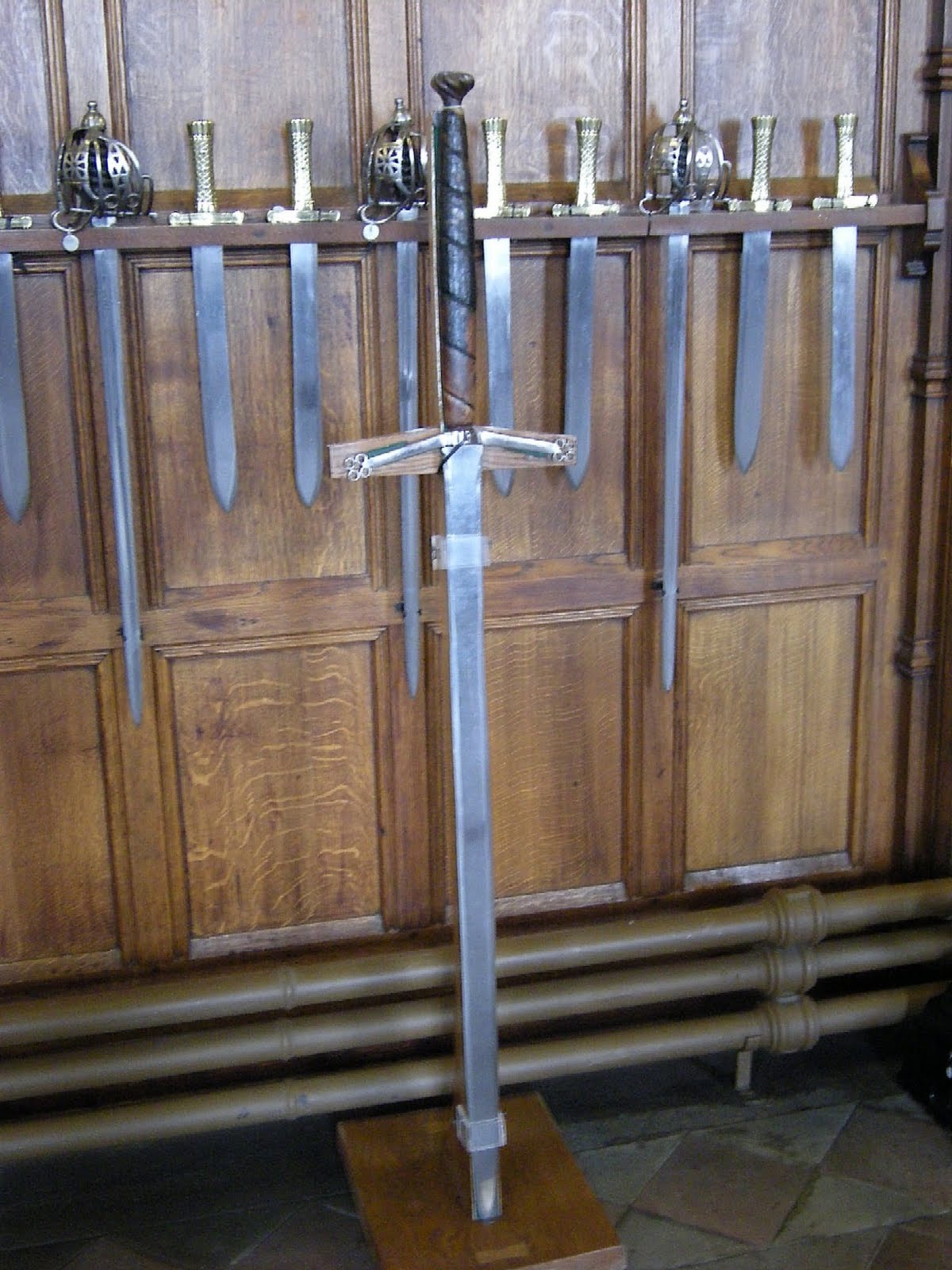
If you think the sword looks too big, take a look at the picture below.
Two-handed 'Highland' claymore
(Edinburgh Castle)
Note the size of the original claymore compared to that of a later basket-hilted sword on either side (which are normally referred to as claymores). This style of weapon is based on early Scottish medieval swords.

Tuesday, 9 August 2011

Montrose Irish, Warlord Games - Part 2

I've finally managed to take pictures of the Warlord Games Montrose Irish command group. I actually finished painting these figures a few weeks ago but I've been on my hols. The main group can be seen in this previous post: Montrose Irish part 1.
Commander
Commander
Drummer
Drummer
The flags supplied in the box set are, I believe, all conjectural. Seeing as they are Irish and not wishing to waste the opportunity for a cliché my brother opted for the green flag.
Ensign
Ensign
Ensign
The ensign originally carried an integral moulded metal flagstaff. I think Warlord must have realised that this pole was too flimsy as the box contains five metal pike although there are only four pikemen in the set. After removing the soft metal flagstaff I drilled out a hole though the figure’s hand and replaced the flagstaff with a cut down metal pike. I can understand why Warlord provided the figure complete with flagpole as the majority of people purchasing the set probably don’t to want to mess around cutting, carving and gluing metal models but I think it’s worth the effort (there’s nothing worse than having a droopy flagpole).

Warlord print their free flags on the relatively thick paper of the information leaflet that comes with the box set. Whenever I've tried to make the flags appear windswept I've found the papers creases and the white paper shows through the printing. In order to cover up these I paint, or use a wash, to fill in the cracks.

I also paint the edges of the flag with the appropriate colour so that the white line of the paper is no longer visible. 
Sergeant
Sergeant
I've just returned from a holiday up north (Carlisle, Edinburgh, Newcastle and York) where we saw numerous sites and artefacts associated with the Marquis of Montrose himself. I hope to post a separate article detailing these soon.

I recently purchased the Warlord miniatures of Alasdair 'The Devastator' MacColla and the Highland hero which I'll add as and when they're painted (but don't hold your breath).

Saturday, 16 July 2011

Charles I and the Isle of Wight

My brother and myself recently returned from the sunny Isle of Wight. One of the main historical attractions there is Carisbrooke Castle. The most famous resident of the castle was, of course Charles I. The onsite museum contains Civil War armour and more interestingly several personal possessions of King Charles I.The majority of the notes below are taken verbatim from the information panels at the castle

“Defeated in the English Civil War which had raged since 1642, King Charles I was under house arrest at Carisbrooke for 10 months in 1647-1648.

At first he had the freedom of the island but early in 1648 John Burley of Newport tried to free him, failed and was hanged. Afterwards Charles was confined to the castle. Still he could walk and play bowels on a green made for him."
View of Carisbrooke Castle from the gatehouse looking towards the motte. Charles’s bedroom was located in the central building behind the ten paneled window in the middle of the picture. The large glazed window replaced a much smaller one. The second attempt was from ruined buildings to the left
Aided by his page, Henry Firebrace, the king tried to escape twice more. In the first attempt he climbed through a window in his bedchamber but he got stuck in the bars."

King Charles slept here (although not in this bed)
Medieval fireplace, King Charles I's bedroom
“This room was the king’s bedroom during his first five months at the castle, from November 1647 to April 1648.

At first he was treated as a quest, but in January he became a prisoner, and guards were place on his bedroom doors. Charles attempted to escape from a small window in this room on the night of 20th March1648, assisted by his loyal servant Henry Firebrace.

There are many later additions here, but the king would have been familiar with the large medieval fireplace, and the medieval chapel window and squint (to the right of the bed).

The bed and chests are reproductions in the style of the 17th century. They have been installed to suggest the style of furniture brought here from Hampton Court in 1647.”

Ruined kitchen and bedroom block
Brother acting as money grabbing guard under the escape window
"The second attempt was made in this area, where kitchens and bedrooms had been built by George Carey 60years before. Charles tried to climb out of the window above... but he was betrayed by two guards. They had taken money to let him escape but then cruelly turned him in.”

On 29th November 1648 Charles was transferred across the Solent to Hurst Castle and then on to London for his trial and eventual execution 30th January 1649.

The isle wasn’t a happy place for the Stuart family.

Parliament was anxious that the children of King Charles could not be used any Royalist plot to restore the Monarchy. Princess Elizabeth and Henry Duke of Gloucester were moved to the Isle of Wight when their brother Charles II arrived in Scotland. It was determined that the Royal children should be imprisoned in Carisbrooke Castle. They arrived at Cowes on 13th August 1650.

Never blessed with strong health Elizabeth died, aged 14, on 8th September 1650 probably from pneumonia and was later buried in St. Thomas Church, Newport.

The church fell into disrepair and the princess’s grave was forgotten until 1793 when it was rediscovered by accident. When Queen Victoria and Prince Albert made the Isle of Wight their family home they felt the final resting place of one of the forebears needed a decent memorial hence the sculptured monument that marks Princess Elizabeth’s final resting place.
18th Century nameplate
Sculpture by Carlo Marochetti
St. Thomas's Church in Newport, Isle of Wight
.
Henry Duke of Gloucester was allowed to move to the Continent where he fought against the Spanish. Shortly after the Restoration he died from smallpox, 18th September 1660, aged 20.