Showing posts with label WotR. Show all posts

Tuesday, 28 July 2015

Boris and Bobby, Perry Miniatures

Here finally side by side are the two similar figures mentioned previously. How I constructed the plastic figure is detailed in a previous post which can be seen [here].

One is a figure I made from plastic parts taken from various Perry boxsets and the other is a standard metal figure available from Perry Miniatures.
Front View
Rear View

All I can say is, if you're going to copy or steal an idea from someone than make sure it's from the best.

Thursday, 16 July 2015

Hunting Party, Perry Miniatures

This set of figures came about as a exercise as to how I could use a number of models given to me as a gift. Why I made a sabot base especially for these figures will be detailed later. 
The pointing left arm was originally taken from the original Perry's 'Wars of the Roses Infantry 1455 - 1487 boxset but this was for a man-at-arms so was covered with plate armour. This was cut away and then greenstuff was used to remodel the cloth.
The second mod was so subtle that I'd forgot I'd actually done it until I came to write up this post. The right arm holding the spear was taken from the Perry's 'War of the Roses Light Cavalry 1450-1500' but as the set represents weapons for horsemen the lance looked too long for this figure. In order to correct this I cut off the spear tip, removed around an inch of the plastic shaft and glued the tip back on.
After (paint)
Before (paint)
I've used a sabot base because there are a set of special house rules available on the Dux Rampant forum which means the dogs can be used as a unit when playing Lion Rampant, which can be found [here].

The dogs were made for Simon Chick (aka Painterman) who has an amazing collection of late medieval figures and is mentioned on the Perry's Light Cavalry boxset as the 'go-to' reference for Burgundians, his blog can be found [here].

I was given these particular models as a give from a friend I met via this blog (hello Derek!)

Monday, 29 June 2015

(Medieval) Civilian Characters, Wargames Foundry

I bought these Wargames Foundry figures (Code: MED 209) a few years ago at a local show intending to use them almost as terrain pieces in games but for some reason never quite got round to painting them. 
Group shoot
With the advent of the Lion Rampant (LR) ruleset I've finally found a use for them. A number of scenarios for LR such as the Fugitive and the Messenger call for a few none military figures. You can of course use any spare knight or soldier miniature but I think it's more fun to use a dedicated/special figure plus it looks better on the tabletop.
Religious and  Lord of the manor characters - front view
"So you're collecting for the church roof?" 
Sculpted by one of the Perry brothers (I'm assuming Michael as he tends to favour the medieval period) these form part of the large range of figures produced by Wargames Foundry. Although these figures are more appropriate for the High to Late Middle ages (they are from Foundry's 100 Years War range) I've be using these for both my 13th century and WoTR games.

Contrary to popular belief and Hollywood the vast majority of people didn't clothe themselves in various shades of brown or filthy raps. It is true that there were strict rules as to what you could wear according to your social status but if you look at contemporary illustrations combinations of red, blues and greens materials are often portrayed. 
Ladies of various social class with the posh Lady of the manor on the right
Black clothes were also popular but idea of the colour being jet black isn't quite appropriate, with various shades of grey probably being more accurate description. What we today would consider true black was a difficult and expensive colour to achieve due to repeated dying process required to produce it. It is probably also this reason you occasionally see it chosen as livery colours by such wealthy people as the Duke of Buckingham for example. It was a deliberate display of wealth and would have indicated the wearer was a person of note or was employed by someone who was. It would have been immediately obvious to someone of the period to identify the class of a person by their choice of clothes and the colours they wore.

This, to a certain degree, still remains the case today whether we realise it or not. Most people will have preconceptions upon seeing someone dressed in a shell suit, baseball cap and trainers just as they will seeing a person wearing a tweed jacket, flat cap, corduroy trousers and Hunter Wellingtons.
Working types - front view
Working types - rear view
Fashions in medieval clothing changed considerably, although obviously not as rapidly as it does nowadays. For a insight into medieval clothing take a look through the famous [Luttrell Psalter].

There is a direct connection to Dudley illustrated in the Psalter but I'll detail this in another post.

Wednesday, 24 June 2015

Sir Boris of Bilston, Modified Man-at-Arms, Perry Miniatures

Seems appropriate to repost this, all things considered:
This is the completed figure I made up from various bits and pieces all taken from the Perry medieval plastic boxsets. Some of the thought process (haha, as if) and techniques are detailed in this previous post/ramble can be read [here].

The choice of blond hair for his bob was deliberate as I wanted to introduce an extra element of colour to the model and hopefully make him stand out on the tabletop. He does now bare an unfortunate resemblance to the current Mayor of London, Boris Johnson, who's full name is actually 'Alexander Boris de Pfeffel Johnson' which does make him sound like a proper medieval baron.
The post title comes from that fact that Johnson was,very early in his career, sent to the midlands by his employer The Times newspaper in an attempt to show him how real people lived. He lodged in Bilston, near Wolverhampton with “a woman called Brenda”. He even claimed that it was this work experience that turned him into a Tory.
My policy on cake is pro having it and pro eating it."
As this miniature bares an unintentionally similar resemblance to another metal Perry figure [here] I may paint up that model and label him Sir Michael of Lichfield in honour of Michael Fabricant, MP for Lichfield, who also sports an equally distinctive (I would say 'comical' but my mom told me not to be rude to strangers) blond hairstyle.

In an attempt to keep this blog balanced I did try to find a bad haircut among the members of the opposition but met with no success (although Ed Miliband did sport a corker in his youth which resembled Henry V's puddin' basin style).

I'm unsure which retinue this model will eventually fit into. I have several options that I have planned including those for the Earl of Warwick, Lord Audley or the Duke of Buckingham, all with relatively local connections. These characters would have enjoyed far larger retinues in real life but I'm limiting them to the six men-at-arms as allowed by the Lion Rampant rules. As I am a benevolent dictator I will probably also allow them to have a limited number of billmen or archer units. Lord Dudley will of course get a full strength retinue (my toy soldiers, my rules).

Wednesday, 10 June 2015

Medieval Bills

This post is more of an observation rather than anything more technical. I often read that a number of medieval weapons were developed from agricultural implements. This is most obvious with weapons such as the flail and the English bill, a type of polearm that has a distinctive shaped head (see images below).
Exhibit A - Weapon or Tool?
Exhibit B - Purpose built weapon? 
Due to my current WoTR project during a recent sight-seeing trip to the Herbert Art Gallery and Museum in Coventry I paid particular attention to their medieval armour collection. The Coventry sallet is probably better known but displayed either side the helmet are two bills. These may be two of the twenty seven bills purchased for the city of Coventry and delivered to St. Mary's Guildhall in 1458. These caught my attention because it was during another visit (to a Victorian pumping station in Burton - I know, I lead a pretty rock'n'roll lifestyle) that I noticed a large display of hand bills (or bill hook) all with quite seemingly random patterns. Talking to the owner of the collection he informed me that the majority on display came a company called Edward Elwell Ltd that used to be based in Wednesbury (Junction 9 of the M6 and IKEA for anyone who is struggling to place it and which is literally down road from where I live). It is known that there has been a forge making iron at Wednesbury from at least the reign of Elizabeth I. Every single pattern and type of bill on display had a unique reference number stamped into it which you could use to order from the company catalogue.
Elwell handbill
Elwell handbills. Note several have a spike.
Elwell handbills
Of particular interest are the bills which have vertical spikes (or so I thought) similar to the shape seen in the weapon version. I asked the owner why an agricultural tool would need to feature such a shape. He then went on to explain that I was looking at the pattern from the wrong point of view. The sharp point isn't the working part, it was actually the V wedge that was used to locate and push over branches and stems when hedge laying. This technique is now quite rare in the UK but can still be seen occasionally in the countryside.

I might be completely wrong (normally am) but looking at one of the medieval bills (exhibit A above) it seemed that it was a bog standard agricultural hand tool that had been 'upgraded' to a weapon by having a horizontal spike forge-welded to it.

In light of this I have altered a few of my own billmen to reflect that they had received a slightly more rural style of bill.


Looking at the models I may, in the future, modify a few other bills so that they look like they have a simple socket joint and remove the tangs from the shaft (I like to give my loyal readers something to look forward to).

Wednesday, 27 May 2015

Lion Rampant - Demo Game - Battle Report


This is a link to a quick demo game played between an old friend Ade and myself, recorded last Sunday. We played with just a few units to demonstrate the core mechanics of the game. Any mistakes in the gameplay are entirely my fault.

Tuesday, 26 May 2015

Small WoTR Medical Vignette, Perry Miniatures

This small vignette was the result of a challenge I set myself one night whilst I was staring at a pile of Perry's plastic WoTR figures (yes, I do need to get out more). With hindsight I purchased two more boxes than I actually need to build a couple of basic retinues using the Lion Rampant ruleset,  although in my defence I hoarded all this lot years ago. 

After successfully altering around a dozen figures featured in previous posts I wondered just how far I could go. One figure in particular struck me that could altered to depict someone lying down. My original thought after seeing that model was to have a prone figure (implying being wounded) soldier receiving medical treatment. The model serves no natural function for any game that I can think of, it is more of an exercise in how far I could modify the figures.
Deciding to commit myself I cut away the bases, always a nerve wracking 'point of no return'. Then looking at the arms I used an standard archer's pair, removing the bow and cutting off the hands so that they could be rotated to form a more natural looking posture when the figure was lying flat. With the angle of the right arm I thought I could imply that the prone figure was trying to prop himself up by his elbow.

As the prone model's right foot was left at an odd angle I cut this part off and replaced it with greenstuff. His left foot was cut and then rotated so that it looked more relaxed.
The second (kneeling) figure involved a lot more chopping and changing. Both legs were cut through at the knee and upper thigh. I should have used a paperclip to form a frame to hold the legs in position but I just smothered the pieces in glue and hoped that they got stay in place (sometimes I annoy myself with my lack of planning). Once dry greenstuff was used to fill in all the gaps. The arms are from the standard trumpeter arms with, obviously, the trumpet cut away. Fortunately the arms naturally looked as if the kneeing figure was either to administer the last rites or is about to offer comfort to the prone soldier.

The sword was made by cutting away the surface detail off the scabbard and smoothing down the plastic. The helmet was hollowed out using a craft knife and hand drill. The arrow was cut away from the standard bundle that comes with the archers.

The following images don't match up but it might help people see how the figures were altered.

Thursday, 21 May 2015

Modified WoTR Foot Men-at-Arms WIP, Perry Miniatures - Part 10 of 10

This figure will eventually represent Lord Dudley but it wasn't my original intention to use this actual miniature. I had always planned on having three matching figures for both my mounted and foot miniatures but as a result of poor forward planning on my part (never one of my strengths) I literally ran out of matching parts for the mounted figureThe figure that will now represents one of Dudley's sons should have been the main man himself. The barbute helmet wasn't my first choice either but I was left without further options. I'd like to claim that this figure is based on the the famous Avant armour on display in Glasgow (images here) but it's just a coincidence. At least it will help the figure stand out among the others wearing the more common sallet variety. 

As I was running out of options for a figure wearing full harness I realised that I would have to make an alternative so I used the same standard body but decided to make the foot figure match the mounted knight.
As far as I can gather the wearing of tabards became quite old fashioned towards the end of the C15th. but I wanted to paint Lord Dudley's heraldry onto the figure (Dudley himself was relatively old when the wars started). This meant I could use standard arm pieces but I would have to modify the upper body to make it look as if he was wearing a tabard over his harness. To do this I used a sharp (i.e. new) scalpel and removed all the detail from the belt upwards such as the stomach and back plates. Once this was smoothed out I then added greenstuff below the belt line to look like material covering the upper part of the tassets (thigh armour). Once this part had cured I added the belt detail using greenstuff.

For the left arm I removed the knife from the standard arm piece and then left the figure on my work bench. I find it's sometimes best to leave figures like this to one side so you can occasionally just glimpse it once in a while. Mistakes or unnatural poses will soon become evident because they will become more and more obvious when you look at them. Although pleased with the results so far I wanted the figure to really stand out more than the others so added the small buckler.

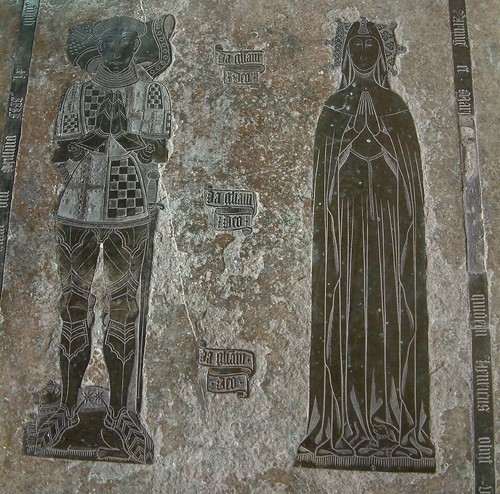
Now I'd like to claim that I did all my research first and then only commit to butchering..sorry, modifying a plastic figure to suit but this is not always the case. As mentioned above I adopted my usual approach and left it to one side to ensure that it 'looked ok'. After a while one detail kept on drawing my eye was the length of the tabard, with me now thinking that I'd given Lord Dudley a mini -skirt. The seeds of doubt were sown after I remembered seeing the brass of William Catesby in St. Leodegarius's Church, Ashby St Leger (it was one of his descendants that organised the GunPowder Plot and which may have been organised in a nearby room next to the churchyard). This brass shows Catesby wearing a close-fitting short-sleeved tabard which is considerably longer than my version and covers half of his thigh. This seemed to confirm my suspicions but before I started mixing up more greenstuff I thought I would just double check to see if there were any more examples. Using Google ('All Hail') Images I happened to come across the following brasses of:

Sir John Say (d. 1478) (Image here)

William de Grey (d. 1495) (Image here)

Sir Henry Greene (Image here)

All show a close-fitting short-sleeved tabard that reveals the tassets just as I had modelled Lord Dudley. I quite like the similarities with Say's life and that of Dudley but I will go into more detail on this when I finally post my epic Lord Dudley mini-series - only five years in the making so there's no rush.

Wednesday, 20 May 2015

Modified WoTR Foot Men-at-Arms WIP, Perry Miniatures - Part 9 of 10

This figure dates back to when I initially parted this project around five years ago, which probably explains why it is only partially painted. I had difficulty remembering what exactly I had done to this figure but I eventually worked out that I chopped up the left arm to re-position it and added the feather plume to the sallet.

This figure could represent either Sir Edmund or Sir Oliver Sutton, sons of Lord Dudley. Edmund probably fought alongside his father at St Albans and Blore Heath (1459) while Oliver was killed at the Battle of Edgecote (1469).

Tuesday, 19 May 2015

Modified WoTR Foot Men-at-Arms WIP, Perry Miniatures - Part 8 of 10

This is a basic figure and arms combo but with the head of poleaxe replacing the usual bill/halberd. I'm hoping the dodgy joint will be hidden by the future paint job.


Friday, 15 May 2015

Modified WoTR Foot Men-at-Arms WIP, Perry Miniatures - Part 7 of 10

Greenstuff


After seeing previews of the latest Perry Miniatures release (light horsemen) I noticed that some of the riders had turn-down boots. I remembered seeing the same distinctive detail in an old Osprey book 'The Swiss at War 1300–1500' with illustrations by Gerry Embleton. 

With this figure I liked the resulting clean look using standard parts straight from the sprue but as my plan was to have as many unique miniatures as possible I realised a simple way to achieve this was to add the boot detail using greenstuff.
This figure was previously shown made up out of standard parts. I decided to add turn-down boots just to add a little variation to the overall look.
For this musician the turn-down boots effect was created once again with greenstuff. It's hard to see but I also cut away the knife from the left hand side of the figure and replaced it with a sword and buckler.
Just to be different instead of new boots this figure has been given a quick makeover with the simple addition of a head band made from greenstuff.