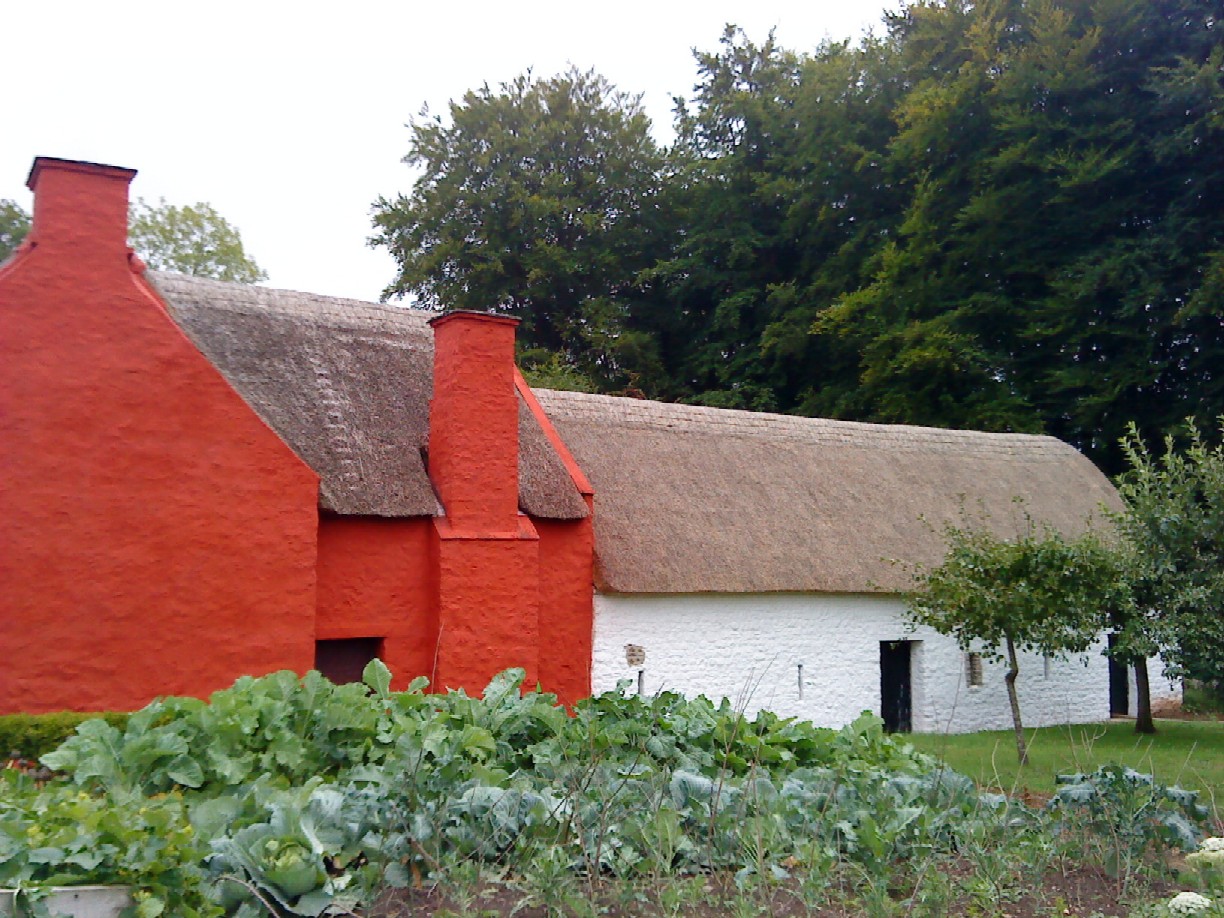
The red walls, created by adding a small amount of coloured pigment such as red ochre into the white wash, were thought to protect the house against evil spirits; as were the red berries of the Rowan tree planted outside.
Wednesday, 25 August 2010
St Fagans National History Museum - Gower Farmhouse
Farmhouse from the Gower, South-west Wales. Originally built in 1610.
The red walls, created by adding a small amount of coloured pigment such as red ochre into the white wash, were thought to protect the house against evil spirits; as were the red berries of the Rowan tree planted outside.

The red walls, created by adding a small amount of coloured pigment such as red ochre into the white wash, were thought to protect the house against evil spirits; as were the red berries of the Rowan tree planted outside.
Tuesday, 24 August 2010
St Fagans National History Museum - Stryd Lydan Barn
The first of of several posts from the St Fagans National History Museum.
Barn, Stryd Lydan, Penley, Flintshire, north-east Wales. Built about 1550.


The oldest, and largest, section of this barn was constructed using crucks forming the familiar ‘A’ frames.
A later addition (around 1600) was built on a high stone plinth and connected to the original structure


Barn, Stryd Lydan, Penley, Flintshire, north-east Wales. Built about 1550.
The oldest, and largest, section of this barn was constructed using crucks forming the familiar ‘A’ frames.
A later addition (around 1600) was built on a high stone plinth and connected to the original structure
Note the carpenter’s marks that allowed the timbers to be first be made on the ground in a carpenter’s yard, numbered and then re-assembled on site, just like modern flat pack style furniture.
Note the different construction technique from that used in the later addition (shown above).
St Fagans National History Museum
Deep in the heart of South Wales is the St Fagans National History Museum. This open air museum is located just a few miles west of Cardiff and houses (no pun intended) numerous historical buildings and structures which have been relocated from all over Wales and been preserved here for posterity. Being a national museum admission to this fascinating site is free.
St. Fagans castle is original to the site and is a late 16th C house built in the remains of an earlier castle. In 1948 the house and the surrounding land were donated to the nation. The building is one of the finest and largest Eliabethan manor houses in Wales and is worth a visit in its own right. The interior is now mainly decorated in 19th C style although if you keep a sharp lookout you may spot late medieval bed showing a pair of jousting knights.
St. Fagans was also the location of an ECW battle. On 8th May 1648 an outnumbered Parliamentarian army, commanded by Colonel Thomas Horton, routed a 8,000 strong Royalist force. Part of the battle took place on the museum land.
We dashed around the 100 acre site but you could easily spend the day there. It was very useful to take note of construct methods and details such as the unglazed windows etc.
There were numerous places of interest including the Working Men’s Institute built, unusually, during the Great War and several reconstructed Celtic round houses. I would also recommend the food sold on site, in particular the Celtic Crunch ice-cream which was proved very popular with the local wasps.
As there is way too much stuff for a single post, I’ve decided to split the images and information into more manageable, bite-size chunks which I hope to post very day this week.
St. Fagans castle is original to the site and is a late 16th C house built in the remains of an earlier castle. In 1948 the house and the surrounding land were donated to the nation. The building is one of the finest and largest Eliabethan manor houses in Wales and is worth a visit in its own right. The interior is now mainly decorated in 19th C style although if you keep a sharp lookout you may spot late medieval bed showing a pair of jousting knights.
St. Fagans was also the location of an ECW battle. On 8th May 1648 an outnumbered Parliamentarian army, commanded by Colonel Thomas Horton, routed a 8,000 strong Royalist force. Part of the battle took place on the museum land.
We dashed around the 100 acre site but you could easily spend the day there. It was very useful to take note of construct methods and details such as the unglazed windows etc.
There were numerous places of interest including the Working Men’s Institute built, unusually, during the Great War and several reconstructed Celtic round houses. I would also recommend the food sold on site, in particular the Celtic Crunch ice-cream which was proved very popular with the local wasps.
As there is way too much stuff for a single post, I’ve decided to split the images and information into more manageable, bite-size chunks which I hope to post very day this week.
Tuesday, 17 August 2010
Timber Framed Building Completed
The images below are of the completed model based on a building in Tewkesbury (detailed in this previous post.) The real building appears to be made of two separate shops/houses which have since been knocked though to create larger accommodation or commercial premises. To my untrained eye the building width appears to be based on the narrow strips of rented land know as burgage plots. These were measured in multiples (or fractions) of a perch i.e. 16.5ft. Towns that have developed around planned medieval market layouts, such as Dudley, still often display this uniform shop frontage.


I'd imagined that this model house was that of a well-to-do merchant that has spend his cash on a home improvement and built a decent brick chimney piece. This has to taken at a stretch because bricks would have been very expensive at the time but not unheard of. Castles at Tattershall, Lincolnshire and Kirby Muxloe, Leicestershire are both excellent examples of brick built structures constructed during the period now known as the Wars of the Roses. In fact Kirby Muxloe castle was never completed because the owner/builder William Hastings, Baron Hastings, was executed by Richard III in 1483. The castle was simply abandoned almost immediately afterwards. Obviously the model can be used to decorate any game table after this period.


I'd imagined that this model house was that of a well-to-do merchant that has spend his cash on a home improvement and built a decent brick chimney piece. This has to taken at a stretch because bricks would have been very expensive at the time but not unheard of. Castles at Tattershall, Lincolnshire and Kirby Muxloe, Leicestershire are both excellent examples of brick built structures constructed during the period now known as the Wars of the Roses. In fact Kirby Muxloe castle was never completed because the owner/builder William Hastings, Baron Hastings, was executed by Richard III in 1483. The castle was simply abandoned almost immediately afterwards. Obviously the model can be used to decorate any game table after this period.
I decided to paint the model in subdued colours for a change. If, and when, I'm in the house building mood I've already designed and drawn details for a timber framed house based on a building in Bridgnorth. I still haven't seen anything I could use to make a convincing thatched roof so I will probably depict a slate roof again.
Tuesday, 27 July 2010
Timber Framed Building
I’ve slowly come to realise that, at least for myself, that modelling and painting are an autumn/winter activity. It’s now late July and I’ve completed very little since I finished the Renegade Covenanters. Over the past couple of months I’ve been enjoying the rare English event of regular sunshine and have spent my spare time sightseeing around the country looking at various castles, country houses and battlefield sites.
So just to show my loyal readers (hello mom) that I’m still actually during ‘stuff’ here is a foam board building WIP.
On another trip recent to Tewkesbury, this time to visit the medieval festival, I experienced a sense of déjà vu. “I know that building” pointing out to bemused friends a timbered framed structure on the main road that passes through Tewskesbury. I recognised it because I’d seen it detailed on this blogspot. There are better and more numerous images on his site.

The model chimney was again made using one the brick versions of the Wills plastic sheets.
The timber frames were made from card, balsa and those stirrers from one of the well known coffee shops. It did occur to me that it may be actually cheaper to buy balsa strips (approx. 20 pence per strip) from your local model shop rather than having to buy an expensive coffee just to get your hands on some of those sticks.

In the future I must remember to be more careful cutting and gluing the foam board. It will prevent me from having to clean up the model afterwards. In retrospect the door I made doesn’t look right, it appears more appropriate for a barn than a residential town house.
As I understand it, the traditional image of black and white timber buildings is largely an invention of the Victorians. Therefore I haven’t yet decided on the final colours although I edging towards copying the original with the grey wood and ochre red walls.
Next up figure-wise should be a number of Warlord plastic ECW cavalry.
So just to show my loyal readers (hello mom) that I’m still actually during ‘stuff’ here is a foam board building WIP.
On another trip recent to Tewkesbury, this time to visit the medieval festival, I experienced a sense of déjà vu. “I know that building” pointing out to bemused friends a timbered framed structure on the main road that passes through Tewskesbury. I recognised it because I’d seen it detailed on this blogspot. There are better and more numerous images on his site.
I had fancied making a model of a timber framed building and thought this would make an ideal reference source. At a push it could be used for both the WotR and ECW periods.
The model size would be dictated be the size of the roof as I was going to use Wills moulded plastic sheets which measure 73mm x 133mm - available from all good railway model shops.
The plans and views were drawn up with a standard CAD package using the photos as guidance working from the roof downwards. The model wasn’t intended on being an exact replica (so that meant I could fudge it where necessary). I decided against creating any windows to save time and effort, indicating their position by leaving the area painted plain black. The chimney piece is based loosely on the one below – seen from the rear of the John Moore museum, Tewkesbury, which is more or less opposite the reference building.
The model chimney was again made using one the brick versions of the Wills plastic sheets.
The timber frames were made from card, balsa and those stirrers from one of the well known coffee shops. It did occur to me that it may be actually cheaper to buy balsa strips (approx. 20 pence per strip) from your local model shop rather than having to buy an expensive coffee just to get your hands on some of those sticks.
In the future I must remember to be more careful cutting and gluing the foam board. It will prevent me from having to clean up the model afterwards. In retrospect the door I made doesn’t look right, it appears more appropriate for a barn than a residential town house.
As I understand it, the traditional image of black and white timber buildings is largely an invention of the Victorians. Therefore I haven’t yet decided on the final colours although I edging towards copying the original with the grey wood and ochre red walls.
Next up figure-wise should be a number of Warlord plastic ECW cavalry.
Saturday, 19 June 2010
Wednesbury - "the worst place in the world"(?)
Wednesbury is a small town located in between Walsall (where I currently live) and Dudley (where I grew up) and was once described by jean wearing, mullet haired TV presenter Jeremy Clarkson as "the worst place in the world" (so make of that what you will). It certainly isn’t the prettiest of places but then again the Black Country isn’t generally noted for its attractive scenery.
If the place name seems oddly familiar it may be because you’ve seen it from the M6 motorway. If you can tear your eyes away from the glass fronted RAC building or Walsall FC’s Bescot Stadium with its enormous billboard and glimpse in the opposite direction you may spot in the distance the parish church of St Bartholomew crowning the highest point in Wednesbury, possibly on a site once sacred to the Saxon god Woden. So if you are ever stuck in traffic on the M6 near Junctions 8, 9 and 10 (which is quite likely most days) here are some interesting facts (and a fair few boring ones) about Wednesbury to help pass the time.
A useful shibboleth is that the place name is pronounced “Wenz-bur-ree” similar to how Wednesday is spoken. If anyone says “Wed-nes-bury” point at them and laugh.

After looking at the site again I read that is believed that a Henry Beaumont may (note the word ‘may’) have fought at Blore Heath in 1459, although I assume this was Henry senior as the younger Beaumont would have only been in his early teens (approx. 13) and therefore legally too young to fight. Medieval families had the unfortunate habit of giving the oldest male the same Christian name as his father so it gets very confusing trying to trace anyone though the period, the Beaumont’s were related through marriage to Lord Dudley’s through one of his daughters.
So although it definitely isn’t worth visiting for a day trip or probably even for a motorway break, Wednesbury certainly isn’t the ‘worst place in the world.’
If the place name seems oddly familiar it may be because you’ve seen it from the M6 motorway. If you can tear your eyes away from the glass fronted RAC building or Walsall FC’s Bescot Stadium with its enormous billboard and glimpse in the opposite direction you may spot in the distance the parish church of St Bartholomew crowning the highest point in Wednesbury, possibly on a site once sacred to the Saxon god Woden. So if you are ever stuck in traffic on the M6 near Junctions 8, 9 and 10 (which is quite likely most days) here are some interesting facts (and a fair few boring ones) about Wednesbury to help pass the time.
A useful shibboleth is that the place name is pronounced “Wenz-bur-ree” similar to how Wednesday is spoken. If anyone says “Wed-nes-bury” point at them and laugh.
The town of Wednesbury is one of the oldest in the area, the probable site of an iron age fort (burgh) or hill (barrow). Wednesbury is reputed to have been fortified by Ethelflaed, daughter of King Alfred, in 916 to protect the borders of the Kingdom of Mercia from Viking raids.
The Domesday Book describes ‘Wednesberie’ as a manor consisting of ploughland and meadows surrounded with dense woodland. ‘Colepits’ are known to have been dug by 1315 and the industrial development of the town began.
With ‘Wednesbury Forge’ established in 1597 and pottery, including the renowned ‘Wedgebury’ ware, produced in bulk from the 1400s Wednesbury was perhaps the most important and wealthiest manufacturing town in the West Midlands before the Industrial Revolution
William (Lord) Paget, Secretary of State for Henry VIII and a Knight of the Garter order was born in the town.
During the English Civil War men of the Shropshire milita heading towards the siege of Dudley castle shot a local after he refused to tell them where the nearest pub was. Speaking of which, the oldest pub in the town is Ye Olde Leathern Bottel, in Vicarage Road, which is believed to date from 1510. They keep their beer well but it is surprisingly expensive for the area.
Just north-west of Junction 10 was the location of Bentley Hall where, on 9th September 1651, Charles II stayed after his defeated at the battle of Worcester. Nothing remains of the Hall but its location is now indicated by a cairn.
John Wesley, the famous Methodist preacher, was beaten up there (several times, in fact) but also preached to Francis Ashby (one of the founders of Methodism in America).
Artist and muse Kathleen Garman was also born in the town. She married the famous sculptor Sir Jacob Epstein. This is one of the main reasons that the couples’ personal art collection is now in a purpose built £21million gallery in nearby Walsall.
The local museum has a very nice collection of Ruskin Pottery. The factory itself was in Smethwick. There is also a sword which belonged to John Ashley Kilvert of the 11th Hussars. It was used by him during the Charge of the Light Brigade on 25th October 1854 during the Crimean War. He was wounded at the battle and left in a ditch until nightfall, when he was discovered nearly frozen to death. He was taken to Scutari Hospital where Florence Nightingale was in charge of the nursing staff. Settling in Wednesbury after retiring from the army, he was elected Mayor of the town in 1905.
And finally, for any sporting anorak types, Wednesbury Rugby Union Club is home of the tallest posts in the world at 38.26m. Yep, that’s just over 125ft high.
I only mention all this because on one of the many day trips taken by my brother and myself during May was a visit to Tewkesbury, Gloucestshire. A definite must see is Tewkesbury Museum that contains an excellent model of the late medieval battle in May 1471. In a happy coincidence I spotted a local knight’s banner/shield - that of Sir Henry Beaumont II of Wednesbury. I only recognised the name because it was mentioned on an excellent website dedicated to the Battle of Blore Heath. I’d been looking at names of local knights that had fought alongside, or against, Lord Dudley at that battle and one of these was Henry Beaumont.
The Domesday Book describes ‘Wednesberie’ as a manor consisting of ploughland and meadows surrounded with dense woodland. ‘Colepits’ are known to have been dug by 1315 and the industrial development of the town began.
With ‘Wednesbury Forge’ established in 1597 and pottery, including the renowned ‘Wedgebury’ ware, produced in bulk from the 1400s Wednesbury was perhaps the most important and wealthiest manufacturing town in the West Midlands before the Industrial Revolution
William (Lord) Paget, Secretary of State for Henry VIII and a Knight of the Garter order was born in the town.
During the English Civil War men of the Shropshire milita heading towards the siege of Dudley castle shot a local after he refused to tell them where the nearest pub was. Speaking of which, the oldest pub in the town is Ye Olde Leathern Bottel, in Vicarage Road, which is believed to date from 1510. They keep their beer well but it is surprisingly expensive for the area.
Just north-west of Junction 10 was the location of Bentley Hall where, on 9th September 1651, Charles II stayed after his defeated at the battle of Worcester. Nothing remains of the Hall but its location is now indicated by a cairn.
John Wesley, the famous Methodist preacher, was beaten up there (several times, in fact) but also preached to Francis Ashby (one of the founders of Methodism in America).
Artist and muse Kathleen Garman was also born in the town. She married the famous sculptor Sir Jacob Epstein. This is one of the main reasons that the couples’ personal art collection is now in a purpose built £21million gallery in nearby Walsall.
The local museum has a very nice collection of Ruskin Pottery. The factory itself was in Smethwick. There is also a sword which belonged to John Ashley Kilvert of the 11th Hussars. It was used by him during the Charge of the Light Brigade on 25th October 1854 during the Crimean War. He was wounded at the battle and left in a ditch until nightfall, when he was discovered nearly frozen to death. He was taken to Scutari Hospital where Florence Nightingale was in charge of the nursing staff. Settling in Wednesbury after retiring from the army, he was elected Mayor of the town in 1905.
And finally, for any sporting anorak types, Wednesbury Rugby Union Club is home of the tallest posts in the world at 38.26m. Yep, that’s just over 125ft high.
I only mention all this because on one of the many day trips taken by my brother and myself during May was a visit to Tewkesbury, Gloucestshire. A definite must see is Tewkesbury Museum that contains an excellent model of the late medieval battle in May 1471. In a happy coincidence I spotted a local knight’s banner/shield - that of Sir Henry Beaumont II of Wednesbury. I only recognised the name because it was mentioned on an excellent website dedicated to the Battle of Blore Heath. I’d been looking at names of local knights that had fought alongside, or against, Lord Dudley at that battle and one of these was Henry Beaumont.
Model of the battle at Tewkesbury Museum (Beaumont's banner is the sixth from the right)
After looking at the site again I read that is believed that a Henry Beaumont may (note the word ‘may’) have fought at Blore Heath in 1459, although I assume this was Henry senior as the younger Beaumont would have only been in his early teens (approx. 13) and therefore legally too young to fight. Medieval families had the unfortunate habit of giving the oldest male the same Christian name as his father so it gets very confusing trying to trace anyone though the period, the Beaumont’s were related through marriage to Lord Dudley’s through one of his daughters.
Henry Beaumont of Wednesbury's Banner (based on information at Tewkesbury museum)
Henry Beaumont II, knighted after the battle of Tewkesbury, fought on the Yorkist side for Edward IV. Beaumont died in November of the same year, aged 25 (possibly from injuries?).
So although it definitely isn’t worth visiting for a day trip or probably even for a motorway break, Wednesbury certainly isn’t the ‘worst place in the world.’
Wednesday, 16 June 2010
ECW Covenanter Command Group
After what seems an age, I've finally completed these figures from Renegade. After painting them I looked through my growing collection of ECW flags for a suitable match. Spotting 'COV 9 - DUKE OF HAMILTON'S REGIMENT' by Body Banners from Redoubt Enterprises, I decided to use these with this set which I'd picked up at the Derby Wargaming Show back in October of last year. I saw the Hamilton description and assumed it was for the William Hamilton, 2nd Duke of Hamilton who died during the battle of Worcester, although after checking their website I realised that they actually represent the flags of his equally ill-fated older brother General Sir James Hamilton 1st Duke of Hamilton. I can only assume that his brother would have carried a similar (if not the same) flag.
As I normally prepare flags on a spare spear/pike this has allowed me to swap and change the various flags I have. In the following images I have used flags taken from the following site Dux Homunculorum.
The Covenanter flags are designed and drawn by Alan to suit his 1/72 scale figures but I think they work perfectly for 1/56 (28mm) scale and, more importantly, they're free - bargain! They are easily as good, if not even better, as several others I have bought. There are more available on the site so it's definitely worth having a look.
"It may have been the colour of Colonel Sir Alexander Sutherland."
"Another ensign captured at Preston in 1648. This was the Colonel's colour for Lord Cranston's Regiment of Foot (the Edinburgh Levies)." Coincidently this is the same battle where James, the 1st Duke of Hamilton, was heavily defeated and later captured.
Unfortunately the 15th Duke, Angus Alan Douglas-Hamilton, died on the 5th June 2010 at at the age of 71. His son, Alexander Douglas-Hamilton, now becomes the 16th Duke.
Subscribe to:
Posts (Atom)