Wednesday, 19 February 2014

English Medieval Ship The Thomas, Zvezda (9038) Scale: 1/72

This is a plastic model (Code: 9038) of an English medieval ship the Thomas, a square rigged cog, from the Russian company Zvezda.
The Thomas
Although labelled as being 1/72 scale the model is quite suitable for 28mm size figures (just remember not to use the tent on the aftercastle/sterncastle).
Detail of forecastle (or fo'c'sle if you're nautical)
I'm not sure if I rigged this bit up correctly as the ropes have to bend over the woodwork to to be secured.

Detail of aftercastle
The clever design of the model enables you to make the ship either with a complete hull (plus stand) for display or as a waterline version. As I don't want to display the model and that I will eventually use this to play medieval naval battles I choose the waterline option (there are plenty of free rules available online, I have a set from WSS magazine). Funnily enough had I owned this model during my youth I'd have nagged my mom to make this with a full hull and played with it in the kitchen sink, or more probably it would have met the same fate as models of the Golden Hind, HMS Hood and the USS Constitution, none of which unfortunately survived the tidal waves caused by me sliding into the bath (I'd like to point out this wasn't recently, I was only about five years old at the time).

As alluded to in previous posts I purchased this model from Mr. Models in Birmingham just before Christmas 2012 for under £40 (available on eBay for less but I try to support local shops whenever possible) so using this as a bathroom toy wasn't really an option.

There is a very similar model on display in a museum in the capital (the London Science Museum I believe) which I recall seeing a number of years ago. This displays the Royal coat of arms of England and with the included decal set with the Zvezda kit you can replicate the same appearance with this model. Although very impressive I chose to paint the sail to look plain and weathered.
Citadel Technical paint Nihilakh Oxide used on the rudder.
Using Google (All Hail) Images to see how other people had modelled and painted up this kit, for use as a gaming piece that is, I noticed that no one had bothered to complete the rigging. As the kit is supplied complete with quite delicate blocks and pulleys I initially assumed that people were simply opting for the easier version and not bothering to complete the kit, even though it comes complete with two sets of coloured string to use for this very purpose. Curious as to why this was the case, I quickly realised why after reading the instructions.

By not rigging up the model the main mast can by pulled out of its locating hole and stored flat. Rigged up properly the mast is firmly secured in place, ideal if you plan to display the ship properly but a major pain if you want to store the model away or transport it anywhere to play with (the waterline version stands 13"(330mm) high. The kit come supplied with separate black and gold string presumably suitable for a royal vessel for use as rigging. However I've never seen rigging this colour so I looked for a more natural looking alternative. First call was my mom's sewing box. After telling me off for making a mess she handed me a reel of white string and asked me if it was any good. The only problem, she added, was that is a type of elastic (cooking?) string. I experienced an all too rare 'light bulb' moment. Fortunately I hadn't glued the mast into place but thought I could use the elastic string to secure the sail and mast to the hulk but still be able to pull the mast out of its locating hole (it needed about 1" (25mm) of vertical clearance. As you can see, and much to my surprise, it actually worked.
Before
After - Collapsed rigging
Unlike the painting the ship following the assembly instructions, which suggested painting the hull in various coloured bands, I decided to check for any references from original medieval sources. After looking at several medieval illustrations I noticed that the ships appeared to be unpainted all except for the crows-nest, which are normally shown painted red or white. This is in stark contrast to images of the later Mary Rose which always appear in illustrations to have been daubed over by eager volunteers with random tins of paint from an interior decorators closing down sale.
In the same display case in the museum mentioned earlier there was another ship with the mainsail painted to represent a ship displaying the arms of the Earl of Warwick. I've seen this replicated a number of times in model form, so I can only assume that the modellers have seen the same display, it would be a rather odd coincidence otherwise. However the model comes with shields that add to the overall decorative look and obviously can be painted to suit your own preferences.
Being a proud midlander I opted to used the basic form of the famous Beauchamp family coat of arms, one of a handful of families that could afford to have a ship like this built. This shield is painted Gules, a fess or (in plain English - red shield with a central horizontal yellow band). The Beauchamp family actually had many branches so to differentiate between themselves the various families used different devices following the same pattern, three above and three below the band. The main, most influential, family used a crosslet but birds, squares etc. were used by other branches.

Zvezda produce other similar plastic medieval ships which I hope to buy if and when I spot one.

Friday, 7 February 2014

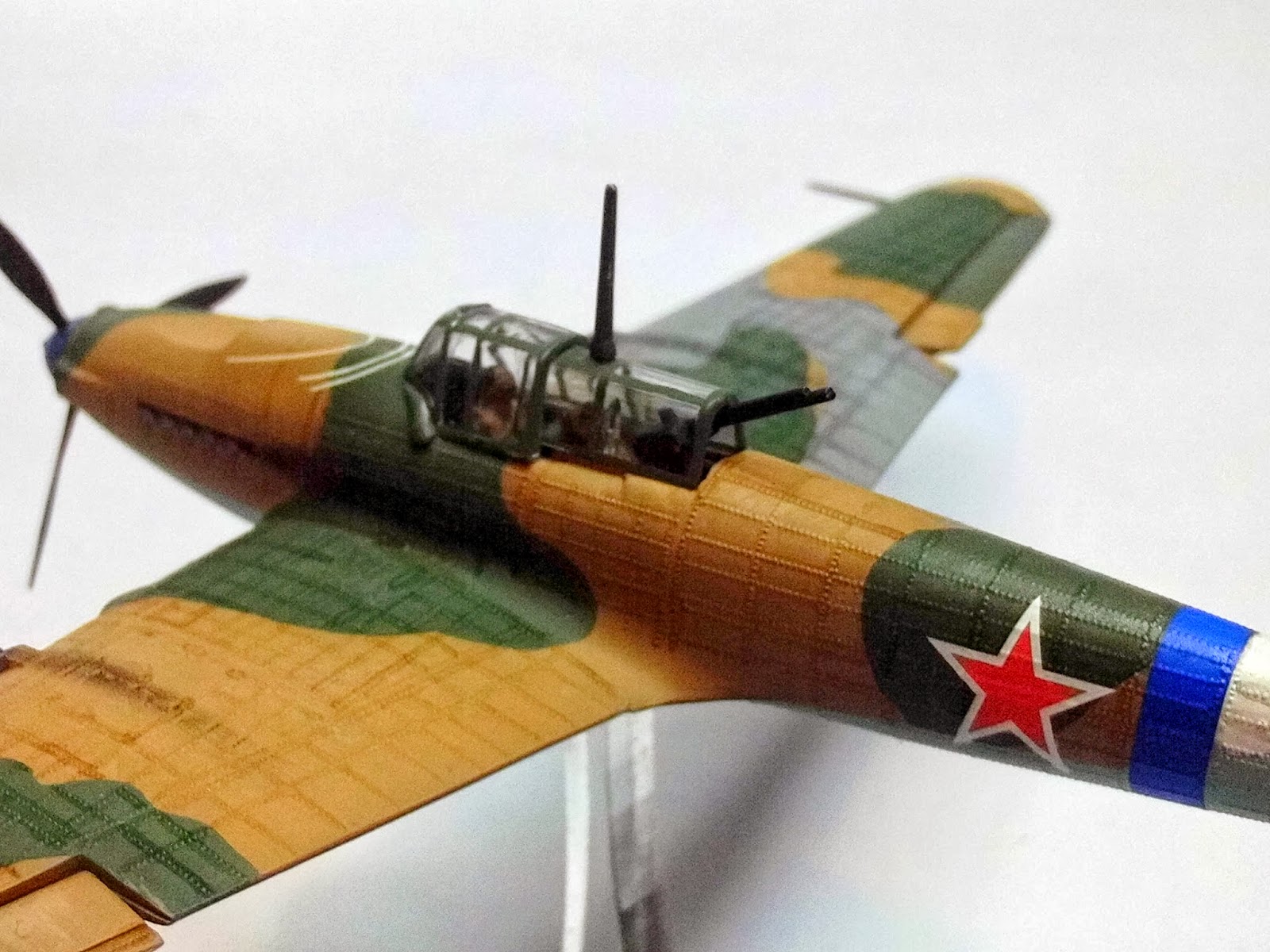
Ilyushin Sturmovik, Airfix (1/72 scale)

Ilyushin II-2M3 of the 233rd Guards Assault Regiment, VVS 1944-45.

From the instruction leaflet:
"The Ilyushin Stormovik, which first entered service in 1941, became one of the best known of all the Soviet Air Force aircraft of the Second World War. It was designed specifically for ground attack and the support of ground force in the battlefields. The Stomovik played a crucial role in World War Two and was described by Stalin as 'as necessary to the Red Army as air and bread." Over 36,000 (36,183 to be precise) Stormoviks were built - more than any other aircraft type in history.

Armament consisted of two 23mm cannon and two 7.62 machine guns in the wings and a single 12.7mm machine gun in the rear cockpit. It could carry either a bomb load of 1000lbs (450 kgs) or up to eight rockets. The IL-2M was powered by a 1770 hp Mikulin AM-38F engine giving a maximum speed of 260 mph (416 kmp). Wingspan was 47ft 10ins (14.58m) and length 38ft (11.58m)."
 

I was deliberately heavy handed with the weathering and shading on this model as I wanted it to stand out on the table.


Ironically the Sturmovik was nearly identical (in appearance and performance) to the little remembered British little bomber the Fairey Battle, still considered one of the worst wartime RAF aircraft.

Thursday, 6 February 2014

Junkers Ju87-B (Stuka), Airfix (1/72)

Junkers Ju 87R-2, 239a Squadriglia, 97° Gruppo, Italian Air Force, Lecce - Galatina, Italy April 1941.

From the instruction leaflet:
"Most famous of all the dive bombers used in the Second World War was the German Stuka or Ju87, designed by Junkers and first flown in prototype form in 1935. This unlovely but functional aircraft entered Luftwaffe service in 1937. Stukas were mainly used as close-support aircraft for the ground forces and this they did with considerable success both in the Spanish Civil War and in World War II. The Ju8B-2, one of the two versions in this kit, was built in large numbers and saw widespread service on all the war fronts, its success in the Polish and French campaigns was tempered by heavy losses during the Battle of Britain, the type being withdrawn at an early stage of the battle...Typical bomb load consisted of a single 250kg (550lb) weapon under the fuselage and up to four 50kg (110lbs) bombs on under wing racks. Armament comprised two 7.92mm MG 17 machine guns in the wings and one 7.92mm MG 15 machine gun in the rear cockpit. Powered by one 1,100hp Junkers Jumo 211 engine, the Ju87B-2 had a maximum speed of 390km/h (242mph). Wing span 13.78m (45ft 3in). Length 10.99m (36ft 1in). Height 3.76 (12ft 4in). "


Arguably the most recognisable airplane from the Second World War this model is to support my Bolt Action Italians.

Wednesday, 5 February 2014

Focke-Wulf FW189A, Airfix (1/72 scale)

Focke-Wulf FW189A
Wk.Nr.2100, 'V7+1H' of 1(H) 32 Luftwaffe, based at Pontsalenjoki, Finland May 1943

From the instruction leaflet: 
"The FW 189A reconnaissance and army co-operation aircraft was known as 'The Flying Eye' and was one of the most important and most successful Luftwaffe types, especially on the Eastern Front. In service the FW 189A completely replaced all earlier tactical reconnaissance and co-operation aircraft and was also used for light bombing missions. It proved extremely reliable and its ability to absorb punishment and defend itself made it extremely popular with its crews. When FW189 construction ended in 1944 over 800 had been built, most of which went into action on the Russian Front. Powered by two Argus 410 engines of 465 h.p. each the FW 189A-1 had a maximum speed of 217 m.p.h. and a range of 416 miles. Armament consisted of four 7.9mm machine guns and up to 440lbs of bombs. Wing span was 60ft 4 1/2ins and length 39ft 5 1/2 ins."


Plastic airplanes by Airfix were probably for most young males, of a certain age in the UK at least, the first introduction to scale modelling. I still have fond memories of walking to the local newsagent,  holding my pocket money in my sweaty little hands, to buy either an Airfix or Matchbox model. It was in fact an advert for a Tamiya scale model that rekindling my interest in modelling/painting/gaming after two decades of apathy towards my childhood hobby. Therefore this may possibly be the first model airplane I've ever actually finished properly. As a kid I rarely painted models, I just made them as quickly as possible to play with them. 
 
There's not a lot I can add to this piece really. The twin fuselages required a fair amount of filling and sanding but it is an attractive and interesting looking model.
There no real secret to painting the framework on the glass canopy apart from keeping a steady hand. It results in a far better looking model than if left simply blank. I painted the crew because they are so visable.  
I built this (and the next two models) with games of Bolt Action in mind. Although not necessary they make a nice visual marker for air attacks during play. As mentioned in the official blurb this plane saw a lot of action on the Eastern Front so it will be ideal for playing games invloving Germans, Italians against the Russians.
The stand is an acrylic base made by Ade with a small magnet attached. A corresponding magnet was then superglued to the underside of the plane (make sure you get the polarity right or it will never work). This way one base can be used for several aircraft.

Tuesday, 7 January 2014

A Miniature Review of my 2013 Preview

After briefly looking back over my 2013 preview post of last year I thought it may be of interest, if only to myself, to reassess the post itself in order to compare and contrast to what exactly I accomplished (it will also help to achieve the probable vain attempt to post at least once a month. So here goes (text in bold italics is taken from the orignal 2013 preview):

'I'd like to wish my followers and visitors to this blog a belated very happy new year.'
Again I realise it's a bit late but I would like to wish a very Happy New Year to all of those kind enough to follow this blog and, of course, all the occasional visitors that stubble across the site. I noticed after the holidays that the blog broke the '200 followers' mark. I found this particular result more pleasing than achieving 100,000 page hits a while ago. This of course is just my personal opinion but its mainly because I've noticed some very odd spikes in viewing figures. I can only assume this is spammers or various other random elements that give false readings (possibly). So once again I'd like to thank everyone that has taken the time and effort to 'follow'.

'I had considered writing a review of 2012 but I don't think there's much point in repeating myself when you can simply skim through the year's posts.
Same, I won't actually review the year as you can simply speed read the previous posts.
 
'I did somehow manage to publish 67 posts which is a personal best for me.'
Whoops - only 28 posts for 2013, a new personal annual record low.

'I don't intend to buy many, if any, figures (famous last words) during 2013. Painting wise I don't intend to set myself any definite targets after I experienced a major case of 'painters block' towards to the end of the year'.
Fail - I bought lots of figures and models (some of which I also happened to paint and finish - hard to believe but true). For some unknown reason I suffered another bout of 'painters block' around the same time in 2013. I do intend to stick to the credo, 'I've not going to buy any more figures this year' (well, all except for a small number of medieval civilians and jousting figures from Curteys Miniatures, of course).

WWII Soviets - Bolt Action
'I aim to field my Soviet forces for Bolt Action as soon as possible so I can actually play a game! I did manage to visit Ade with his brother Jon just after Christmas a play a few games.'

A fair amount painted but no way near enough. Too many of these figures are just primed or even worse still just bare metal. It didn't help that I bought even more Bolt Action figures although these were Italians.

'Medieval Stuff
I hope to finally complete the Great Round Tower that I started back in September. Recently, when I was struggling to see how I could make any progress, I was tempted to wear it as a hat and stroll around town pretending to be Abraham Lincoln or Isambard Kingdom Brunel. Realising this would probably result in me being detained in a padded cell for the foreseeable future I've opted instead to try and finish it. Either that or I'll boot it into the nearby park and give the local squirrels a new folly they can call home.'
Completed! Blimey it only took me a full year to finish the infamous Great Round Tower and no squirrels were harmed in the process.

'I'm hoping to complete a lot more medieval figures, concentrating on representing genuine characters from throughout Edward I's life and times...'
More on this a little later.

'I purchased a great big Zvezda model from Mr. Models in Bearwood, Birmingham... probably as far removed from the 'love bombing retail experience' you get when you visit a certain chain of high street wargaming stores as is possible. The model itself is the largest model I've ever bought and is something I'm looking forward to making.'
Again - completed! Hurrah for me. A very nice model, more complex than I initially thought. I know now why the model is normally shown incomplete. I had a cunning plan that actually worked and allowed me to depict the model as it was intended. Don't worry, all this will make more sense when I post images of the model (as soon as I manage to take some photos). 

'I also have a eight part posting ready to go on Sir John de Sutton VI, Lord Dudley, a fascinating character from the Wars of the Roses period. The only snag is that I still haven't painted any appropriate figures yet!'
Nope, embarrassingly still not a sausage and a continuing personal bugbear but I did however manage to paint up one of his Dudley baron predecessors, Roger de Somery.

Scales
'I plan to paint up a few other figures in different sizes from my normal 28mm (shock, horror). All I'm going to say is that there are some great big figures and an awful lot of tiny figures waiting in the queue.'

Nope, another complete failure on my part.

'As I'm sure is the case with many other modellers/wargamers I have dozens of ideas and little side projects ideas floating about in my head regarding terrain, figure modifications and various plastic model kits. One thing which hopefully I'll be able to do is post a few tutorial videos (any suggestions or requests will be considered) via Ade's site. You may even see me on a few of Ade's Bolt Action battle reports.'
We did actually manage to play and record a couple of games for Ade's YouTube channel.

So although it may not appear so, judging from the distinctly low quantity of posts, 2013 was a relatively productive year for me despite numerous setbacks. I have made steady progress painting figures and making models.

After Ade's enforced career change and his move into full time wargaming I really need to knuckle down and produce more videos for his site. The amount of time and effort involved in making the battle reports to the standard that Ade is now achieving is quite daunting but also rewarding.
 
It's gradually dawning on me that skirmish level games are the way forward for me personally. A number of factors have influenced my thinking on this:
  • I generally prefer 25/28mm size figures,
  • my own glacial pace of painting limits the number of figures I can produce annually,
  • my preference for linear narrative scenarios which will naturally lead to campaigns.
So basically I'm recreating my childhood and playing similar games I did as a youngster such as the old classics Cry Havoc and Siege.

Speaking of which one of the highlights of the forthcoming year will be the launch of a new set of medieval skirmish rules, from the famous Osprey Publishing, Lion Rampant written by Dan Mersey. This is due in autumn 2014. I've been fortunate enough to have been able to make a small contribution to the rulebook. I'm not exactly sure what is being used so I won't spoil it by posting any of my own images here until after its release. This however is the cover:
Some eagle-eyed readers amongst you may have already spotted this image before, like my smarty-pants brother did, as Osprey used it as the cover for their January - June 2014 catalogue (which then confusingly failed to make any reference to it). The success of their new range of wargaming stand- alone rulebooks seem to have taken Osprey by surprise, something they admit to on their website. It's going to be interesting to see where they go with this series.

I'll be posting a fair few articles nearer the launch date relating to painted mounted knights based on the Anglo-Welsh wars (perfectly suited for skirmish games and campaign), medieval buildings and other appropriate terrain; a number of which will be in video format via Ade's own dedicated Wargaming For Fun site plus his YouTube channel.

So at least I'll be able to guarantee some new material over the coming months. How the large majority of bloggers manage to deliver quality and quantity posts continues to baffle me but I intend to better last years effort (which shouldn't be too difficult). 

Hopefully I'll be attending shows/conventions in Alumwell WMMS (held over the border in wild Wolverhampton), Derby and BlogCon in Nottingham. After missing the inaugural event this is one convention I really would like to attend. So if you're planning to be at any of these shows please feel free to introduce yourself.

So the final Word of 2013? For me it has to be 'Defenestration' - a fate that very nearly befell a number of my work colleagues towards the end of a long year!

Wednesday, 4 December 2013

9th 'Pasubio' Division, Italian Infantry, Warlord Games

These figures* represent members of the 9th 'Pasubio' Division. This was a motorised Infantry Division of the Italian Army during World War II and served in both the Yugoslavian and Russian campaigns. 
Breda Light Machine Gun crew - gunner and ammuntion bearer
with Capitano (captain).
 
Rear View of Light Machine Gun crew.
Note Capitano's yellow loop rank insignia.
 
As with most other modellers and gamers of a certain age Airfix were the only real source of affordable historical figures in our formative years. My brother had a set of 1/72 scale WWII Italians in the familiar soft grey plastic. They were always attractive figures and, from purely personal point of view, they have far less negative connotations associated with the other Axis forces.

Even though the Italian army's reputation during the war is still generally held in low regard here in Britain (I won't repeat the jokes here) the famous phase "Lions led by donkeys" (often unfairly applied to British soldiers and generals during WWI) is probably a more appropriate epitaph for the Italian forces in WWII (infantry attacking tanks single handed, anyone?).
 

An Italian Infantry Division normally consisted of two Infantry Regiments (three Battalions each), an Artillery Regiment, a Mortar Battalion (two companies), an Anti Tank Company, a Blackshirt Legion (Regiment of two Battalions). Each Division had only about 7,000 men. The Infantry and Artillery Regiments contained 1,650 men, the Blackshirt Legion 1,200, each company 150 men.

And according to the Perry Miniatures website:
"An Italian Platoon was divided into 2 squads of 20 men. Each squad was made up of 2 Breda light machine gun groups of a corporal gunner, assistant gunner and 2 ammuntion bearers, all commanded by a sergeant. The other 11 were made up of riflemen."

However the Pasubio were a binary division composed of two regiments, rather than the normal three, the 79th and 80th Roma Infantry regiments (plus the 8th Artillery Regiment). Neither regiments were assigned a Black Shirt Legion on the Eastern Front.

The 79th Infantry Regiment and 8th Artillery Regiment were made up of men from Verona, whereas men from Mantua made up the 80th Regiment. Although in different regions, Lombardy and Veneto respectively, these northern Italian cities are in fact only 45km (28miles) apart.

The soldiers could be recognised by their red/yellow/red striped collar patch.

The division was mobilized in August 1940, and took part in the invasion of Yugoslavia in April 1941, capturing Split and Å ibenik, Dalmatia (now in modern day Croatia).


When Germany invaded east into Russia on 22nd June 1941 Hitler only informed Mussolini, the dictator of his Axis partner Italy, once the invasion had actually started. Eager to have a claim for a share in the 'spoils of war' Mussolini insisted that Italian forces would assist the Germans.**

So in early July an initial force of 62,000 personnel of the Italian Royal Army formed the 'Corpo di Spedizione Italiano in Russia' - CSIR (Italian Expeditionary Corps in Russia) mobilized to take part in invasion of the Soviet Union.

Arriving via Ukraine and Romania in August 1941 the Pasubio took part in the Battle of Two Rivers (the Bug and the Dnieper).

In September the Pasubio and Torino Divisions along with the German SS Viking took the town of Dnepropetrovsk, Ukraine, winning rare praise from the German commander. The CSIR later covered the left flank of the German 11th Army (German Group South).

Along with the Torino, Prince Amedeo Duke of Aosta and Sforzesca divisions the Pasubio would suffer greatly in 'Operation Saturn' in December 1942. Attacked by the Soviet 1st Guards the Italians were surrounded and defeated; the commander of the Italian armoured force, General Paolo Tarnassi, being killed in an aerial bombardment.

Remnants of the divisions remained in Russia until May 1943, when it was withdrawn to Italy. The division was being reformed and refurbished in the Salerno area when it was captured by German forces.
Left: Sergente (corporal) armed with
9mm Beretta M1938A sub-machine gun.
Right: (lance cpl) armed with standard 6.5mm Carcano rifle.
 

Note the red/yellow/red striped collar patch.

Useful Reference books:
If anyone is interested in collecting an Italian Army for use in the European theatres with rules such as 'Bolt Action' or 'Chain of Command' I would highly recommend on following books.

The Italian Army 1940-45 (1)
Europe 1940-43
Osprey Men at Arms 340

The Italian Army 1940-45 (1)
Europe 1940-43
Osprey Men at Arms 353

The Italian Army at War
Europe 1940-43
Concord

In the Name of Roma!
Actions of 80° Roma Infantry Regiment on the Eastern Front: August to December 1941
Chris Stoesen

The Osprey books greatly helped in working out paint schemes and also solving one piece of equipment that had me puzzled. Some of the Warlord figures have a cone-shaped bag on their left hip, which was normally out of shot in the period photographs. The Osprey book revealed that it was M1935 gasmask bag which was normally utilized during the war as an extra storage bag.

The Concord book might be a bit more difficult to track down (try specialist bookshops such as Iain Allen). I grabbed a copy at a large model show for a bargain £5.

The Roma book is actually a scenario book available in PDF format directly from the author and is stuffed full of useful information. The fact I chose to paint my figures as part of the Pasubio division is a happy coincidence. Although primary written with Chain of Command in mind it is easily to play the scenarios using Bolt Action rules.

The book contains six campaigns with between four and six scenarios per each campaign. The book costs $11 US (approx £7) and if you're even vaguely interested in the Italian involvement on the Eastern Front is a must buy bargain.

The Roma book is available here:
http://cstoesen.blogspot.co.uk/2013/09/in-name-of-roma-is-released.html

Italian Infantry Painting Colour Reference.
The following list is the same as the one I keep in my 'little black book' in which I keep (or try to but usually fail) my painting references, model ideas, historical notes etc. These are just the main block colours, obviously free feel to adapt to your suit own paints and methods for applying shading and highlights. Hopefully this may be of some use for anyone starting from scratch.

Grey Green V866 Vallejo - Uniform & M1933 Helmet
Black Shade 34A Foundry - Shoes, webbing, ammo pouches etc.
Med. Sea Grey V870 Vallejo - Garters/Bindings
Black Grey V862 Vallejo - Ground sheet/Blanket
Russian Uniform WWII V924 - M1929 Camouflage cloth (tent/poncho) Base colour A #
Dark Flesh Citadel - M1929 Camouflage cloth Highlight B
Buff Leather 7B Foundry - M1929 Camouflage cloth Highlight C
Flat Brown V984 Vallejo - Rifle stock
Khaki V988 Vallejo - M1935 Gasmask Bag etc.

*If some of these look familiar it's because they were originally due to be Alpini figures (WIP post). After some feedback from Italian viewers saying that Alpini uniforms were more green/grey rather that grey/green I decided to use these figures as standard infantry. Instead of repainting the figures (I'm not as daft as I look) I removed the feathers and simply touched up the paint on the helmets. I hope to purchase a few of the new Perry Miniatures WWII Italians and use these as the Alpini.

**Just as the little known Corpo Aereo Italiano (CAI) the Italian Air Corps expeditionary force involvement in the Battle of Britain, the Italian experience in Russia would result in high casualties in exchange for little or no gain.

#M29 Telo Mimetico (camouflage cloth) was the longest used military camouflage pattern in the world from 1929 until 1992. There were at least three quite different patterns used by the Italians (and Germans) during WWII.

Thursday, 28 November 2013

Partisans, Warlord Games

These figures present partisans or members of resistance movements during WWII. 'The French term "partisan", derived from the Latin, was first used in the 17th century to describe the leader of a war-party' - thanks Wikipedia, I never knew that.

Please note that these are the contents of two packs of figures. 
Group 1 Front
Group 1 Rear
 
Group 2 Front
 
Group 2 Rear
 
Group 3 Front

Group 3 Rear
 
 
Group 4 Front
 
Group 4 Rear
 
The packs are supplied with a mixed set of eight from a certain random number of figures. With the two pacts I've purchased thirteen out of the total sixteen are unique sculpts. The figures come with a mixture of civilian, military clothing and equipment (mainly Soviet but with a Thompson sub-machine gun and a German stahlhelm helmet thrown in for good measure). Suitable for resistance fighters in several theatres including Russian/Soviet, French maquisards (with their berets) or possibly usable for Dutch, Jewish, Polish, Yugoslavians partisans etc.
 
I had been struggling to think of suitable colours to use as I could find very little info or colour reference images of casually dressed (especially eastern) Europeans from the 1930's and 40's. However it was whilst sitting in my local pub that I happened to notice the television was showing the latest episode of Foyle's War (a British detective drama television series originally set during World War II). 'Hello' I thought, 'this may be helpful' so I settled back with pint in hand and noted that all the male civilian clothing which seemed to be variations of rather sober shades of grey, blue and brown. Therefore I have deliberately painted these figures with a relatively subdued colour scheme, which makes sense seeing as they are supposed to represent sneaky partisans ready to ambush any passing bad guys. 
Whenever possible in the future I'm going to do all my research down the pub. It certainly won't improve the quality or quantity of my painting output but I'll be too pickled to care.
Regular readers (hi mom) may have been somewhat surprised to know that I've actually prepared, modified, primed and block painted dozens of Soviet soldiers for my on going Bolt Action project but I do have various excuses for the distinct lack of finished miniatures: 
  • I was waiting to pick up the official Bolt Action army book,
  • Ongoing research into clothing and equipment,
  • I lost my USB cable so haven't been able to download any photographs,
  • I'm a lazy arse who is far too easily distracted.
With the death of Google Reader I've been missing numerous updates on the 500+ blogs I follow (Google+ is also getting on my nerves but that might be because I'm getting old and grumpy). It was whilst pondering this I remembered that I hadn't posted for a quite a time myself. In fact I realised that I had nearly missed two consecutive months, which would have been for the first ever since starting this blog. After checking it also dawned on me that this blog been going for five years (five years exact last Sunday to be precise) - doesn't time fly when you're having fun. So without making any promises I'm going to try and post on a more regular basis i.e. more than once every eight/nine weeks!
 
And, as always, thanks for reading.