Saturday, 3 December 2011

Tecumseh, Conquest Miniatures

This is figure depicting the famous Shawnee leader Tecumseh (March 1768 – 5th October 1813) from the Eastern Woodland Indians range from Conquest Miniatures, Item Number: 500-012. The two figure set also contains Tenskwatawa. A detailed account of his life can be found on-line at Wikipedia
Tecumseh
Tecumseh
Tecumseh
Article taken from the Conquest Miniature website, temporary (hopefully) unavailable, covering the appearance of Eastern Woodland Indians by Tim Greene:
Shawnee Tribe
"The Shawnee, meaning “southerners”, were a tribe of wanderers who were often invited by other tribes to live among them because of their reputation as fierce fighters. An Algonquian speaking people closely related to the Sac & Fox they lived from the Great Lakes region to the Carolinas. The Shawnee claim to have prevented the Iroquois from completing their conquest of the Ohio Valley. They certainly resisted white expansion into the Ohio Valley more fiercely than any other tribe. They threw up a great leader in Tecumseh who came very close to creating a pan-Indian confederacy, which might have slowed or even halted the westward expansion of the white frontier.


Shawnee men wore tanned leather breechclout small with short flap in front. Deerskin leggings above the knee gartered below the knee with fringes along the side seams and fastened to a belt with straps. Garments were simple, sometimes decorated with fringes. Other ornamentation was rarely used; when it was arrow, chevron, and zigzag designs were preferred. The roach was rarely worn by the Shawnees. Men shaved the head in front and attached feathers at the back or left the hair long and loose. Some Shawnee wrapped their long finger woven sashes round their heads like turbans. Moccasins were soft-soled one piece with a seam up the front from toe to instep covered by quillwork. Cuffs were small and turned down. Face paint was usually red. Very, very fine lines were sometimes tattooed on the face. In overall appearance the Shawnee were rather simple and plain compared to the other tribes.


By the early nineteenth century all the tribes were wearing a lot of cloth manufactured in England or America, especially calicoes and red or blue strouding. Sashes were often woven around the head like a turban. These five tribes were some of the major players in the Ohio Valley. The next installment will look at the tribes of the Great Lakes region."

Friday, 2 December 2011

Pontiac, Conquest Miniatures

This figure of Pontiac (c. 1720 – 20th April 1769) is from the Eastern Woodland Indians by Conquest Miniatures, Item Number: 500-011. A brief account of his life can be found thanks to Wikipedia.
Pontiac
Pontiac 
Pontiac - note body tattoos. 
I thought I would attempt to depict the figure decorated with tattoos. After a brief Google search which initially resulted in some frankly bizarre and random images I eventually found something more appropriate. These were loosely based on the body art ‘worn’ by the Iroquois character played by Mark Deacascos in the entertaining 2001 French film ‘Brotherhood of the Wolf’.

Following article taken from the Conquest Miniature website, temporary (hopefully) unavailable, covering the appearance of Eastern Woodland Indians by Tim Greene:

Ottawa Tribe
"The Ottawa were too far north for agriculture and their land was poor in the wild rice so abundant in the land of the Dakota and Chippewa. There also was few fur bearing animals in Ottawa country. So the Ottawa became great traders. This honed their diplomatic skill and they eventually produced one of the greatest Native American leaders, Pontiac. The Ottawa had a reputation for cunning, treachery, and cruelty. They were adequate warriors. Very loyal to the French they were the nucleus of anti-British hostility after the French and Indian War.


The French often remarked on the prevalence of nudity among the Ottawa’s. Men usually wore only a robe and moccasins. Sometimes a fitted leather breechclout was worn with flaps in front and back, decorated with quillwork. Leggings, when worn, were thigh length simple tubes of hide, fringed on the outside seams and gartered just below the knees. Among the Ottawa the roach was worn by some men. The head was often shaved except for a central tuft standing high from front to back decreasing in height towards the back and a scalplock hanging from the crown. The hair could be worn in two or four braids sometimes wrapped in fur or thongs. Others allowed the hair to hang loose or shaved it all except for a tuft at the crown. Ottawa moccasins were deerskin and sometimes moosehide one piece soft soled with seam from toe to instep and the sole puckered into it. The seam was often covered with a strip of quillwork. Cuffs were usually attached and could be worn down or up around the ankle fastened with thongs. The sole was later puckered into a U or oval shaped vamp as among the Ojibwa.


Ottawa men were commonly tattooed. Designs included lizards, snakes, and geometrical figures, sometimes covering the entire body. The face and body were painted with red, brown, green, and black."

Thursday, 1 December 2011

Black Hawk, Conquest Miniatures

Regular readers of this blog may be surprised to see these latest figures but I have actually held a long interest in both the American War of Independence (AWI) and the War of 1812, in the latter Native Americans played a very active roll. My own interest actually dates back to a fondly remembered holiday road trip taken with my brother back in the mid 1990’s and involved driving from Boston to New York via Toronto and Niagara.

Along the way we visited numerous locations associated with these conflicts such as Concord, Lexington, Mohawk Valley, Saratoga, Queenston Heights and several fortifications including Forts George, Niagara and Erie.

Probably one of the least well know theatres of war during the Napoleonic period the War of 1812 helped strengthen both the American and Canadian national identities although it is still largely unknown here in the UK.

Therefore to redress the balance ever so slightly there are the first of many figures I am preparing to represent this period.

I won’t insult anyone’s intelligence by pretending to know much about these historical figures so rather than give a detailed history I thought I’d provide a number of useful links instead. from sites such as Wikipedia.

These figures are from the Eastern Woodland Indians by Conquest Miniatures, Item Number: 500-011. Their website is currently being updated so (without permission) I have included a few notes taken from tribal articles that previously appeared on their site (these appear in italics). Hopefully they’ll re-instate the articles once the website is up and running properly.

First up is Black Hawk (1767 – 3rd October 1838). This figure comes in a set of two, the other being Pontiac which I will detail in another post.
Black Hawk
Black Hawk
Black Hawk
Portrait of Chief Black Hawk
by Charles Bird King
The Black Hawk figure is obviously based on this portrait and shows the sculptor’s skill in recreating a historical character.

Following article taken from the Conquest Miniature website, temporary (hopefully) unavailable, covering the appearance of Eastern Woodland Indians by Tim Greene:
Fox Tribe
"The Fox were an Algonquian speaking people who may have originally come from the Michigan Peninsula. They were part of the Fire Nation, a confederacy also containing the Sac, Kickapoo, and Mascouten who were driven into Wisconsin during the invasions of the Great Lakes region by the refugees fleeing from the Iroquois.  The Fox were especially formidable fighters.  In the 18th Century they unwisely chose to single-handedly oppose the French while simultaneously alienating most of their neighbors.   This resulted in the near destruction of the Fox Nation.  The remnants were taken in by the Sacs and became the Sauk & Fox Nation.


Fox men wore breechclout and moccasins in summer with thigh length leggings and a shirt added in winter. Leggings were fairly fitted with fringes at the sides and large pointed flaps at the bottom, which covered most of the foot.  The leggings were seamed up front and had garters sometimes of fur. Geometric quillwork and later floral and traditional moosehair embroidery decorated garments which were lavishly covered, more so than among the Sauk.  Garments could also be painted in bright hues in solids and stripes or figures and designs like the Miami.  Among the Fox the roach was almost universal.  Men shaved the head with a tuft running from front to back left on and a scalplock left hanging from the crown. The tuft was sometimes shaved leaving the scalplock and roach and the top part of the shaved skull was painted red. Some Fox wore a turban of otter fur.  A few sported buffalo horn headdresses captured from enemies like the Sioux and Iowa.  Some Fox wore a tuft from side to side rather than front to back on the shaved head. One segment of the tribe wore their hair long and loose.  Fox moccasins were soft-soled one piece with a seam up the front from toe to instep covered by quillwork.  Flaps or cuffs of men’s moccasins were of exaggerated size and heavily decorated with quillwork or embroidery in geometric patterns, each flap with a different design then reversed on the other moccasin as for the Sauk, Miami, and Potawatomi.  Fox warriors used red and black pigments.  Some Fox chiefs painted by a European artist had their faces painted blue. Yellow, red, and black stripes could be painted on the lower half of the face.  Hands painted on the body meant an enemy killed in hand-to-hand combat."

Thursday, 6 October 2011

Scots Dragoons, Warlord Games - Part 2 of 2

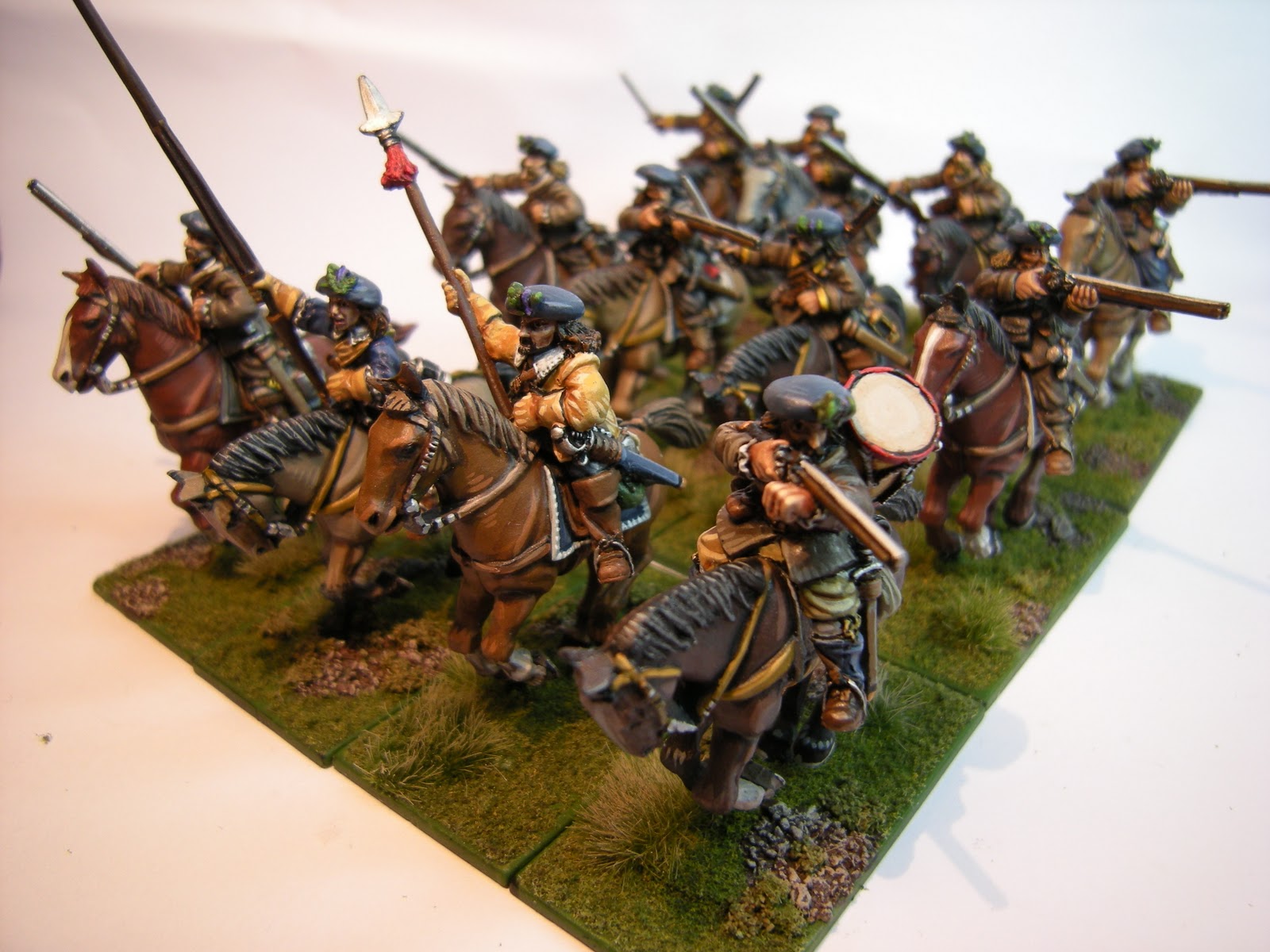
The mounted versions of these dragoons are laden down with loot/provisions including rabbits, chickens, lanterns and bottles of liquid refreshment. I must admit that it took me a while to figure out just what exactly was hanging from the saddle but it is definitely worth trying to highlight these details.


Dragoon with rabbit


Careful planning (or just a bit of forward thinking) is needed when fixing the mounted figures to their horses otherwise some will appear to be sticking their firearms right into their colleagues ear holes - never a good idea.
Mounted dragoons on mass
Dismounted dragoons.
As with the Scots Covenanter infantry I painted the majority with blue bonnets, complete with sprigs of heather and saffron shirts. As regular readers will know I'm a complete muppet and will not be surprised to know I forgot to take any photos of the Covenanter Saker I also painted for Warlord Games.

Wednesday, 5 October 2011

Scots Dragoons, Warlord Games - Part 1 of 2

Further to the infantry detailed previously I was also asked by the chaps at Warlord Games to paint up a set of Scots Dragoons that nicely compliment their Covenanter figures.

There are twenty four figures in total, these depict twelve mounted and dismounted versions of the same Dragoon. It's useful to remember this when you are preparing and painting the figures, especially regarding the bonnets as there are definite matching pairs.
Ensign - Mounted and on foot 
Ensign
Ensign
Dragoon officer - mounted and on foot
Dragoon officer
Dragoon officer - rear view
Drummer - Mounted and on foot
Drummer
Drummer - rear view

Next up will be more of the rank and file figures.

Tuesday, 4 October 2011

Scots Covenanters Warlord Games - Part 2

Here are a few more individual close up shoots of the Scots Covenanters from Warlord Games. The first are the metal command figures. Typical of WG metal miniatures they are full of detail and reward careful painting. I think if you click on the images you'll get a larger version pop up.
Captain
Ensign
Billy the Piper
Sergeant 
Sergeant - Rear View 


Pike Block
Musket Block
After a recent chance meeting with those nice chaps from Warlord Games, Messrs Stallard and Sawyer (BANG, CLANG - sorry, that was just the sound of my blatant namedropping), I asked if it was ok to post my own crappy pictures of Scots Covenanters (and several others) on this blog.

I understand that these figures will feature in an upcoming newsletter (i.e. they will have been photographed properly) but with the large volume of new products WG are producing this might not appear for a while.

Monday, 3 October 2011

Scots Covenanters, Warlord Games - Part 1

A while ago Warlord Games asked me to paint up a set of their Scots Covenanters infantry. The main challenge was attempting to paint Hodden Grey. It's an unusual colour; not exactly grey and not really brown. Take a look at the ceremonial dress of the modern Territorial Army London Scottish Regiment to see what I mean. On reflection most of these figures are too light/grey as I tried to copy the box art (if in doubt - blame someone else, in this case the excellent cover artist Peter Dennis) rather than the browner version seen in some of the figures. Anyway you live and learn.
Covenanter Regiment

Command Group detail  
Note the damaged flag complete with bullet and cannonball holes. Don't tell anyone but it wasn't my initial plan to use this particular flag (also provided with the box set). I cocked up and ruined the undamaged version so replaced it with the one shown.
Command Group
Part of the brief was that the the command group and the four of the pikemen were to be based individually. This is a practical method which would enable them to be photographed. Easy peasy for the command group as least. However the position of the separate pikeman had to planned because if I had positioned them all centrally then there is no way the bases would have lined up. Therefore the rear placed pikemen were offset to their right and the front pikemen were offset slightly to their left. Hopefully this makes sense when you look at the photos above.

The blue bonnets complete with sprigs of heather and saffron shirts are all quite subtle but really do make these distinctive figures stand out but also make gives the unit a cohesive look.