Monday, 23 January 2012

Cap'n Ogre Avery - Champion (Crusher), Part 2 of 5

Modifications: Naval style headwear, musket, telescope and parrot.

In order to make this ogre champion stand out I decided to give him a distinguishing head piece. Familiar to anyone who's watched a period British navy film the distinct bicorn hat was made first by giving the figure a basic skull cap made from greenstuff. Once this was cured I made the two halves of the hat by simply making a flat circular disk, dividing it into two equal parts; then moulding it around the skull cap at a jaunty angle. Well he is a pirate champion after all. As a finishing touch, I added a cockade and ribbon.

The musket was taken from the Warhammer Empire Militia set. The hands and arm were removed, then cut and shunted onto the right hand ogre part which was itself a standard piece holding the club (from the ogre box set); the top and bottom parts of the club being simply cut away.

The telescope was from a handful of spares that I 'borrowed' from Ade taken from, I believe, another ogre set. I removed a section of the telescope's barrel and did a 'cut and shunt' job with a spare left ogre hand part. 
"This parrot was deceased." (apologies to any Monty Python fans)
 The idea for the parrot came very late; I was literally ready to prime all the figures when I saw in a Sunday newspaper a picture of Eddie Izzard starring in a television version of Treasure Island. Sitting on his shoulder was a beautiful multi-coloured parrot. Ping, light bulb moment! All pirate themed ogres should have at least one dodgy looking bird crew member.

I initially contemplated making a bird from scratch but being a lazy bugger I wondered if I could utilise something else. In the dark, dim recesses of my mind I recalled seeing some type of bird being supplied with a set of Games Workshop figures. It took a while to remember where this was but it finally dawned on me. It was in the Warhammer Empire Archers set. However once I'd located the box and had a look, the bird wasn't a hawk or a similarly suitable model, it was a dead pheasant being held aloft by one of the archers, pierced by an arrow. Fudge cakes!

After a deep breath I carefully removed the archer's hand and arm, the arrow and the legs. Feathers were cut back into the plastic using a scribe and a scalpel. The head wasn't in the correct position so I chopped it off, cut the neck at an angle and repositioned it in a more natural looking position. However it still looked like a pheasant. So out came the greenstuff and I tried to bulk out the head and neck. The greenstuff would also help secure the head onto the body. I'm not entirely happy with the final result (I personally think it still looks like a deceased pheasant) but it's close enough.
Dirty Bird
The parrot's legs were replaced with two pieces of brass rod. I used these to pin the parrot into the ogre's shoulder. Once fixed in place, I used greenstuff to fill in any gaps and created claws from thin rolls of greenstuff. All this helped to secure the parrot on to the model.

Sunday, 22 January 2012

Ogres, Games Workshop - Part 1 of 5

Ahoy there shipmates and me fellow landlubber hearties (sorry, that's enough pirate talk from me), these plastic ogre figures from Games Workshop detailed in this post were made and painted especially for my old shipmate Ade. He has a very entertaining YouTube channel 'WargamingForFun' (does exactly what it says on the tin) which is mainly based on games using Games Workshop's Warhammer Fantasy, although he has plans to expand to cover other gaming systems and manufacturers.
Ogre Avery and his merry band of cut-throat pirates
As I wanted to give Ade something in return for all of his recent hospitality in his man-cave I offered to paint up some figures for him. Making and painting fantasy figures is an ideal opportunity to do something completely different from my usual drawn out historical projects.

If you watch the videos you may notice one of Ade's current favourite army's is that of the Ogre Kingdom. The basic core units of the army are obviously your standard Ogres, these are big figures, literally twice the size of other figures. They are currently £23 for six ogres (£3.83 per figure). Ade had himself recently completed some very impressive figures based on a pirate theme, so with this great idea in mind I decided to have a go myself. Ade handed over two ogres but I suggested a group of four, giving me an ideal base from which to start; the usual three figure command group plus a normal figure to even up the numbers.

Some of the painting and modification ideas were immediately obvious.
Pirate flag - check,
Wooden false leg - check,
Cutlasses - check,
Pistols and muskets - check.

With all this in mind I armed myself to the teeth, proper pirate fashion, with scalpel, plastic cutters, needle files, greenstuff and paintbrushes and went to work. I was in modeling modifying heaven.
Ogres crossing Abbey Road
I've played down the butcher aspect of the ogres and tried to emphasise the more nautical theme. I'll go into more detail on individual posts highlighting the modification on each figure (hence five posts in total).

Regarding the overall 'look' of the figures I used my normal basic technique of block painting, applying the appropriate coloured wash and then finishing with a complimentary highlight to the base colour. As pirates didn't have a standard uniform back in the ye olden days I decided to keep the paint jobs relatively simply. Bog standard Citadel Foundation paints were used straight from the pot, using a different colour for each ogre's clothing; although it may be worth noting that I intentionally used red on each figure to tie them together colour-wise as a group.
Ogres coming back across Abbey Road
The bases were simply covered in sand and painted with Foundry's Base Sand 10A, B and C.

Painting-wise these miniatures are never going to be Golden Demon winners, but that was never the plan. Look closely and you'll see that they are actually quite crude. This isn't false modesty on my behalf or a crude amount to fish for compliments, for instance I don't blend the paints and apply multi-layered highlights. These figures are meant to be handled and played with. In fact they have already survived being dropped several times and the drunken attempts of an pickled painter (i.e. me after an evening of drinking real ale) having a go at them.

I'll be publishing four more posts on these ogres, one every day. So, in the immortal words of Casey Kasem, "Details coming up!"

Wednesday, 11 January 2012

New Approach for 2012 - Twitter

As I'm sure regular readers will agree, I'm fully aware how little I actually post regarding models or miniatures on this site. As the title of this blogspot indicates my interests range far and wide. Consequently the posts may often appear quite random with miniatures featuring less frequently than I'd like. However, believe it or not, I do actually produce a lot more than it may appear.

Obviously I normally tend to 'press the button' only once I'm completely happy that the post is ready to be published. For example I have an eight part (minimum) posting ready to go on the subject of the late medieval Lord Dudley. The only thing preventing me from finishing the painting of the figures is that simple fact that I can't determine exactly how the livery colours are halved. Sad but true.

Another of several reasons for this is due to the fact that I try to get the uniforms and histories as accurate (and readable) as possible before I publish a post. The correct shade of dark blue for US infantry from the War of 1812 anyone? Nope, even after numerous purchases of pots of paint, I'm still looking. I have dozens (and dozens!) of miniatures primed and ready to paint.

Likewise for the ongoing War of 1812 project I can't establish a (relatively) small colour detail for a set of British 19th Dragoons miniatures. It's not the fact I'm concerned that someone might point out the error, it's just that I'd know it might not be correct and it would annoy me endlessly.

Another factor is commission work. I've painted a number of new, unreleased miniatures for companies that I can't post here yet for obvious reasons. These can take up a lot of my painting time and then I just have to wait until the relevant company releases them. For instance, the Scots ECW Dragoons, commissioned by Warlord Games, were completed nearly a year before I could put any images or posts online.

Hence the painfully slow post rate. Unfortunately I don't have the time, content or inclination to post everyday (or even every week) here on Blogger. Anyway, back to the point of all this waffle; in a vain attempt to prove I'm not just completely lazy I've decided to use that other great modern time-wasting invention: Twitter. As I have the attention span of a disinterested goldfish, I'm hoping that this will help me maintain a degree of focus. I hope to post (tweet?) on that site on a far more regular basis; almost in a 'Dear Diary' style and use this blog as before, for the completed projects. Well that's the plan anyway.

A link to the site can be found via the page conveniently labelled Twitter or via this link: https://twitter.com/#!/UbiqueMatt

Friday, 30 December 2011

Monnow Bridge, Monmouth

Monmouth is a town in the south-east of Wales, probably best known amongst those interested in history as the birthplace of King Henry V (16th September 1386).

Of particular interest is the Monnow bridge. The following info is taken from panels located on or nearby the bridge itself.
"Monnow Bridge built circa 1270, as a town defence is the only surviving medieval bridge in Britain with the gate tower standing on the bridge. The gatehouse has served as a toll-house, guard room, gaol and dwelling house."

"Monnow Bridge was built in about 1272. However, it was not the first bridge at this site. In 1988 construction works for the flood alleviation scheme exposed the remains of an earlier timber bridge. Analysis of the timber dated the construction to about 1140. The remains are preserved below the river bed, under the existing bridge."


More information about the bridge can be found here.

Surprisingly the bridge remained in use as a road bridge until as recently as March 2004 when a new bridge opened just a short distance downstream. 

The Millennium Plinth  is located nearby. Made from 40 tiles illustrating the town's history, the two below caught my attention detailing aspects from the ECW .
Millennium Plinth detail
The normal toy soldier posting service will be resumed shortly (honest), but until then I'd like to wish all the followers and readers of this blog a very Happy New Year for 2012.

Sunday, 18 December 2011

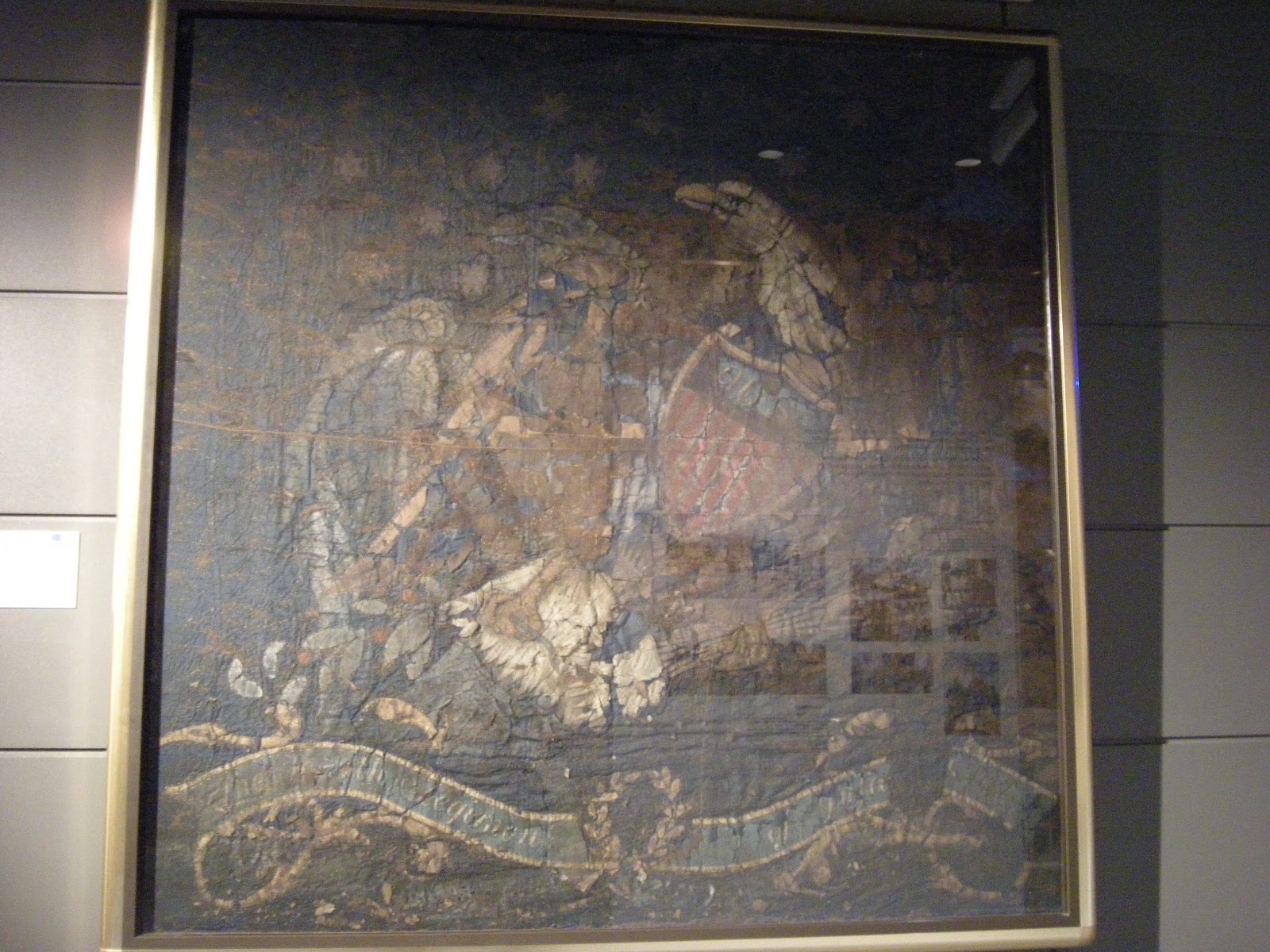
National & Regimental Colours, 4th American Regiment of Infantry, 1812

On a recent visit to the fine principality of Wales, we visited the Museum of the Welsh Soldier  located within Cardiff Castle. The museum covers the development and history of the modern 1st The Queen’s Dragoon Guards and The Royal Welsh Regiment.

Sharing a joint interest in the period my brother called my attention to the following display.
Quote from information panel:
"National Colours and (above it) a fragment from the Regimental Colour of the 4th American Regiment of Infantry. 

These are extremely rare. The Colours (flags) are the heart of an infantry regiment. The US Army has not lost many. These Colours were surrendered to our 41st Foot after the capture of Fort Detroit on 16 August 1812, during the War of 1812."


National Colour - Detail of Eagle
'The Forth Regiment' detail
Interestingly the US Army didn't use the famous 'Stars & Stripes' during this period.

You are not allowed to use flash photography in the museum and the lighting around the flags are deliberately keep subdued to protect the habit, hence the poor quality of the images (that's my excuse and I'm sticking to it!).

Due to the low lighting levels I couldn't tell if the Regimental flag was buff, white or yellow, the traditional colours used. Versions of this flag, suitable for 28mm figures, are available from Flags of War - 1812 US Regiment flags.

As far as I'm aware the only other US flags from this period still held in British hands are in the Shropshire Regimental Museum at Shrewbury Castle. These are the flags of the 68th , 85th and the 1st Harford Light Dragoons captured, oddly enough, by the British 85th Light Infantry.

Friday, 9 December 2011

Scots Saker Cannon, Warlord Games

Regular readers may remember this particular post showing Scots Dragoons where I mentioned that I had also painted a saker cannon for the same company. Anyway reading about one of the latest releases from Warlord Games, New Alexander Leslie, Lord Leven I scrolled down right down to the very end and noticed these familiar chaps: Scots Saker Cannon (click on the images to enlarge them).

I had actually initially painted the carriage red but around the same time I attended a re-enactment display at Kenilworth castle. Speaking to the interesting crew manning the artillery one fellow mentioned that Scots artillery was 'associated with the colour yellow' as he phased it. I went back home and re-painted the carriage and was reasonably pleased with the results.

I've been temporary distracted by other periods (and shock horror - another scale!) at the moment. but I do have some more ECW pieces on the workbench but these will hopefully feature some time in early 2012. Looks scary when you write that date down, doesn't it? Where has the year gone?

Saturday, 3 December 2011

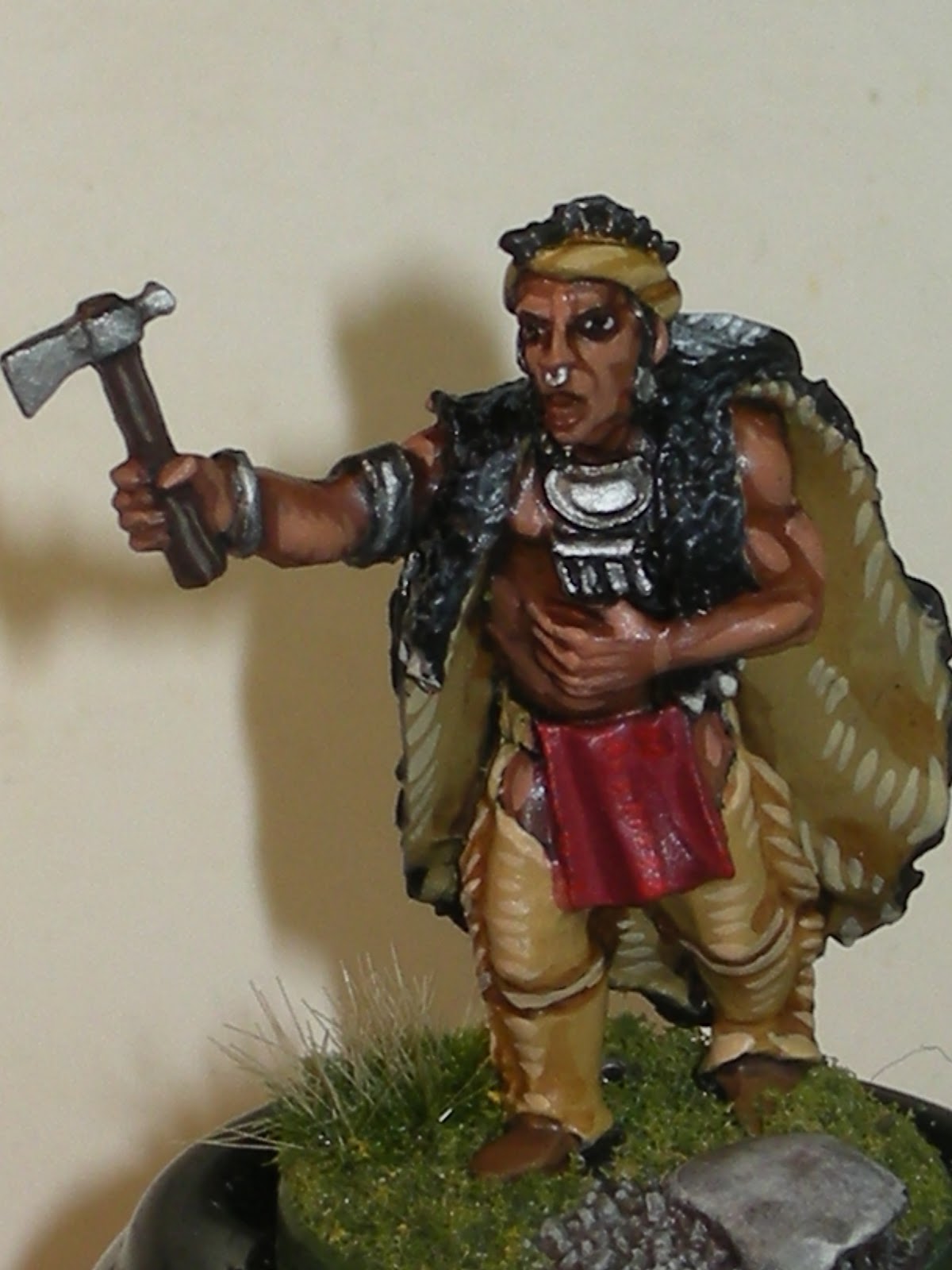
Tenskwatawa, the Shawnee Prophet, Conquest Miniatures

Tenskwatawa, (1775 – 1836) was the brother of the famous Tecumseh. Tenskwatawa was himself a religious and political leader of the Shawnee tribe. This figure is from the Eastern Woodland Indians range by Conquest Miniatures, Item Number: 500-012. The two figure set also contains Tecumseh.
Tenskwatawa
Tenskwatawa
Regulars readers may be even more surprised to know I actually plan the colour schemes of these figures such as using predominately reds and blues for the materials. The feathers are painted to represent eagle feathers and the animal skins are painted to represent black bearskin as this species (I believe) inhabit that particular part of the world.