Friday, 26 November 2010

Painting horses WIP

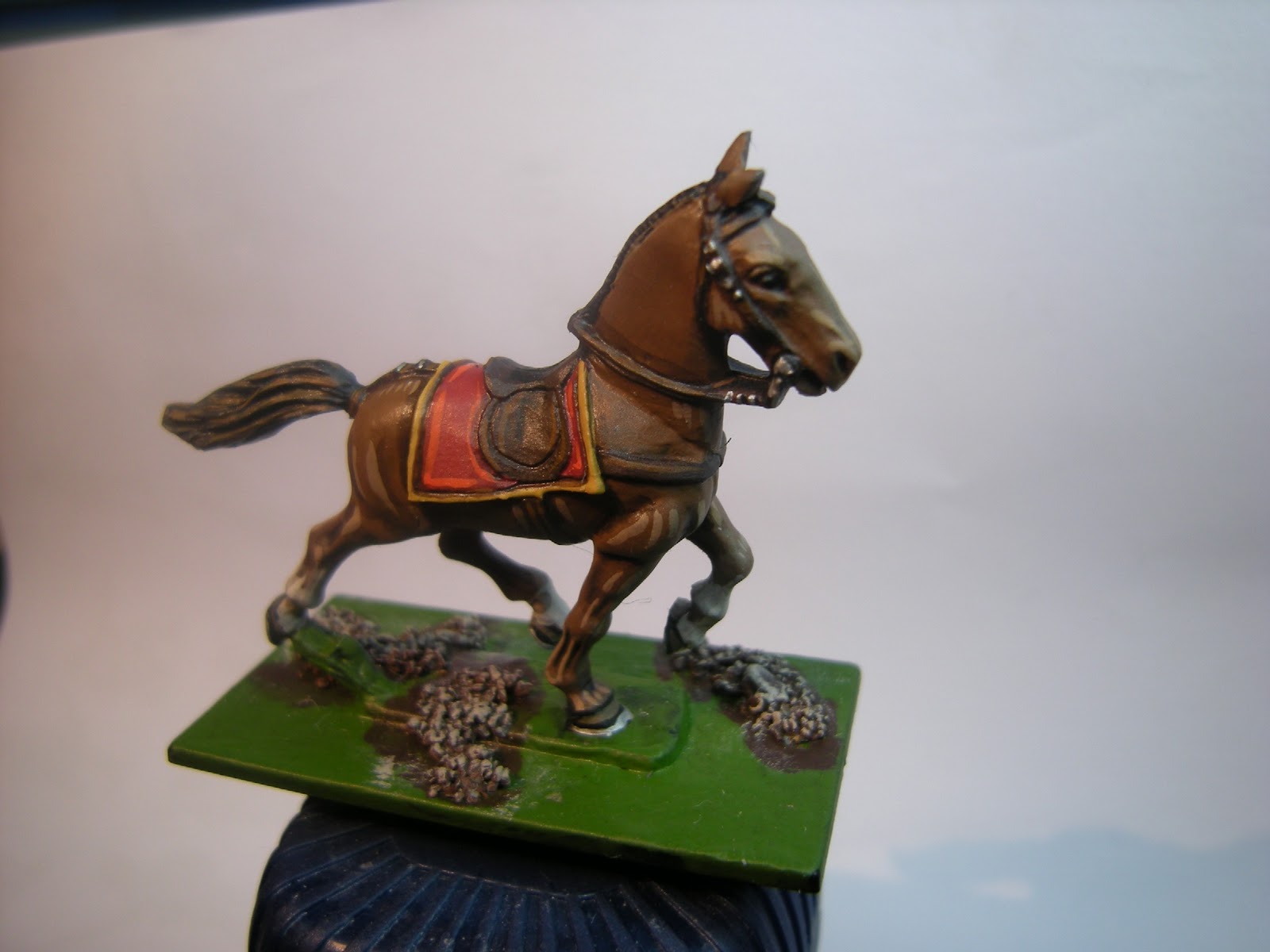
As life thankfully returns to normal I now hope to post on a slightly more regular basis. For a long while I have been putting off completing any cavalry figures because of one simple reason - I really didn’t fancy painting any horses. In fact, the idea was so daunting that these are the first horses I’ve ever attempted to paint. It’s funny how you can feel intimidated by a bunch of toy soldiers sitting there, just waiting on your desk with their cold distant stare.

These WIP models has all been prepared using Citadel paints. The caption refers to the main colour used. The leather work is a mix of either Calthan Brown, Scorched Brown or Snakebite Leather.

Bestial Brown

Astronomican Grey

Astronomican Grey
These plastic horse bodies, from Warlord Games, are supplied in two halves which allow you to create numerous variants from within the pack. One small problem is there is often a pronounced joint line/gap, especially noticeable along the neck joint. If you really want, you could use filler but I use either Revell or Humbrol precision poly cement/glue. The brand isn’t really significant (it just depends on what’s available in my local model shop) but the applicator is. I simply run the tip of the metal tube along the visible joint line and let the glue flow between the joints, this melts the plastic and creates a smoother appearance. The same method can be used to hide the joint lines on tank gun barrels although it would be better to use a brush in that instance.

When it comes to horse colours I normally use Google Images as reference as I found that trying to paint from memory doesn’t work for me; copying straight from real life is far easier. Even when the horses are the same colour a lot of variation can be added by painting a different style of blaze/sock etc.

Calthan Brown

Adeptus Battlegrey

Scorched Brown & Dheneb Stone
Here is a link to a very informative GW article about painting horses.

As usual I used my basic technique, namely block painting the main areas, then adding an appropriate wash to create the shadow detail and then finally a commentary highlight. Slapping on the initial paint with a big brush onto a large model can be a relief after during more detailed uniform work.

I had imagined that the attractive looking dapple grey horses would be difficult to paint although this too is relatively easy. Again, using my same standard block, wash and highlight technique I finally cut the tip off an old brush and dabbed (almost dry-brushed) the highlight colour onto the flanks, belly and neck of the model to create the subtle dappled effect.

Attention to simple details such as painting hooves a paler colour if the sock is white and painting on horseshoes is, I believe, well worth the extra effort.

Hopefully this post will encourage anyone to paint a few model horses. They won’t bite - unlike some of the nasty, big, real versions.

Tuesday, 9 November 2010

Time and circumstance

Regular readers may have noticed the distinct lack of posts for October. Some may even echo the words of singing underwear magnet Tom Jones and say “That’s not unusual”, but, in fact, the month of October and the start of November were a complete write off regarding painting and modelling. My excuse, and it is rather a good one, is that after a relatively minor and routine operation my Dad experienced complications; he endured further major operations and week long stay in Intensive Care, spent longer in a Surgical High Dependency Unit and finally onto a normal ward. He’s currently enjoying being waited on hand and foot at home. One senior consultant even described him as a “tough old bird” which, although not a medical term, does now seem remarkably appropriate. It got to a point when watching the TV drama show ‘Casualty’ I recognised, and even understood, several of the medical acronyms being used (It's surprising how quickly you can annoy your family by repeatedly saying, “Yes, I concur with that doctor's diagnosis”).

What's this got to do with with blog? Well, not much really but oddly enough, whenever I could grab a few minutes (literally) to paint I have found it quite therapeutic. Without wishing to sound too flippant, painting has actually enabled me to ‘switch off’ from worrying about more serious issues, if even for only a short while. Perhaps I should write 'Zen and the art of paint brush maintenance`?

Although I doubt if little toy soldiers will ever be available on prescription from the NHS (which is a great pity) I honestly think it has helped keep me relatively sane over the past weeks.

Normal service will, hopefully, resume shortly. This includes the completion of an interesting project I was working on for someone before being rudely interrupted by ‘time and circumstance’ and which I hope to detail sometime in the future on this blog site.

Monday, 4 October 2010

Derby Show 2010

On Sunday a few friends and myself traveled north up the A38 enduring both the absolutely terrible weather and my equally terrible directions (“Turn right here” when I was pointing left etc.) to attend the Derby Wargames Show. This is one of the few shows I’d marked in my calendar to attend as I enjoyed it that much the previous year.

As my finances are rather limited this year I actually had a budget in mind and I think I showed remarkable restraint in sticking to it, unlike my brother or my other mates that came along. One friend spent more on a single rule book (Warhammer Ancients) than I did in total. I recommended that he should borrow a sallet from one of the medieval re-enactors to protect himself when his wife found out how much he’d spent. In fact I only purchased a few Perry miniatures, a pack of ECW cavalry, a couple of their metal WotR men at arms to mix in with their plastics and a few pots of paint. One reason for this restraint was because I still have books unread and figure packs unopened that I purchased from the same show last year.

For some reason (too busy browsing?) I completely forgot to take any pictures until we were about to leave and people were packing up but I did manage to take one shot of the main display area. The large ‘L’ shaped table in the middle held a massive game of the Battle of Waterloo with had a number of eye-catching Prussian troops on display. A friend did take plenty of pictures of the games so I’ll try and persuade him to post the images on-line.

I had a chat with the chaps from Warlord Games. It was worth having a closer look at their painted figures on display. Their new plastic Prussians had been given an excellent paint job making the relatively simple figures look very striking, although it’s not a period I’m interested (at the moment).

I even managed to spot a number of the new’ish Minifigs 28mm War of 1812 figures which my brother purchased. I remember when we visited Queenstown Heights, on my brother’s insistence, many years ago on holiday which left a strong impression on me.

The venue is the main university building and has decent facilities for attendees. A clever touch from the organisers was that there was also a mini beer festival set up in the student bar with a nice selection of real ales from the Derby Brewing Company. Hurrah for decent beer.

I would recommend this show to anyone if they had the opportunity to attend as my friends and myself had a thoroughly enjoyable day out (even though we did get totally drenched).

Thursday, 30 September 2010

Damaged Sconce

As I was recently in a 'terrain' mood I finally finished this particular modular section of the sconce model I worked on this time last year. As I'd earlier made a section of damaged linking section I thought it would be more likely that a corner section would also suffer damage - hence this model shown below.


The gaps are wide enough for a 40mm sq base to pass though easily. The ramps created by the fallen earth have been made so that figures will stay in place if they haven't quite managed to breach the walls. I deliberately kept this model free from battle clutter but I'm now tempted to add a few details such as broken swords, muskets etc.

Previous posts relating to the construction of the models and the history of the real thing can be foun
here.

Sunday, 26 September 2010

Bridgnorth, Shropshire

Compiling the previous blog entry for the Baxter house I realised I was trying to put too much information into a singular post about a model building. Therefore here is a separate post relating more to the town of Bridgnorth itself.

Looking at the St. Leonard’s Close today you would find it hard to believe that it had ever witnessed scenes of extreme violence. On the 8th March 1646 during the English Civil War Parliamentarian besiegers broke through the churchyard defenses and a running battle developed. The town commander Colonel Billingsley and twenty five of his men were killed defending this area from the Parliamentary forces. Later during the same siege, when the church was then being used by the Parliamentarians as an ammunition store, a shot from the castle caused an explosion that destroyed most of the building and started a fire that damaged a large area of the upper town. The body and tower of this now redundant church are mainly Victorian although some traces of medieval building still survive.

St. Leonard's church, the Richard Baxter house is just round the corner to the left of this picture. 

Just a short distance away to the south of the St Leonard’s sits, at a jaunty angle, the town’s castle. In 1642, King Charles I described the view from here at Castle Walk as 'the finest in my domain'. Little remains of the castle apart from the famously tilted (15° off the vertical) Norman stone keep. It always makes me smile thinking about the Parliamentarian engineers seeing the keep as the dust settled, after all their efforts to slight it. I imagine they simply scratched their heads, threw down their pickaxes and walked away either cursing or praising their medieval counterparts.
If you look carefully you may notice the iron hooks on the outside of the left hand wall. It is believed these were added during the ECW siege so that mattresses and other padding could be hung off them to soften the blows from artillery shot coming from the direction of the church.

The TV series Time Team excavated the Castle gardens to the left and behind this picture, looking for any remains of the bailey, and found absolutely bugger all.

On a strange and darker note, fairly recently (2005) papers relating to Operation Sealion were discovered in Germany. These indicated that if Hitler and his Nazi henchmen had conquered Britain Bridgnorth was a proposed location for the German headquarters. Factors such as its central location, good road and rail links, nearby airfield and a small local population were considered to have made it an ideal, and relatively safe, administration centre for the midlands. It’s quite a sobering thought to imagine German jackboots goose-stepping up and down the quintessentially English high street.

View from the Railwaymans Arms looking towards the castle grounds. The keep is immediately to the left of the tallest tree in the background.

On a far less sober note, there are numerous decent pubs throughout the town, but one I would recommend is the Railwaymans Arms. Located on the platform of Bridgnorth station, at the north terminus of the Severn Valley Railway line, it’s very atmospheric even if you don’t particularly like steam trains. Depending on what time you visit it can be like walking into a museum or a film set. And of course the beer is excellent. The pub also gives you a good view of both the castle and the siege earthworks, now called Pan Pudding Hill, built by Henry I in 1102 and located just on the other side of the railway tracks. There is a modern footbridge from the castle gardens over the main road which will take you right to the station.

If you don't want to walk that far then the The White Lion Inn on West Castle Street (yep, near the castle) is also worth visiting.

Saturday, 25 September 2010

Richard Baxter's House, Bridgnorth, Shropshire.

Born in Rowton, Shropshire, Richard Baxter (1615-1691) has been described as the “chief of English Protestant Schoolmen”. A Puritan theologian, church leader, poet, hymn writer, he lived in Bridgnorth for almost two years from 1640 – 1641. 

By 1638 Baxter became a master at a free grammar school in Dudley were he started his ministry, after being ordained and licensed by the bishop of Worcester (anybody else notice how often I crowbar Dudley references into my posts?). He moved to Bridgnorth shortly before the outbreak of the English Civil War (ECW). During the war Baxter was a chaplain for Colonel Edward Whalley’s Regiment. He later turned down an offer from Cromwell to become the chaplain for the NMA Ironsides.

Much later in life he had a rather unpleasant encounter with George Jefferies, now better known as the Hanging Judge after his suppression of the supporters of the Duke of Monmouth after the Battle of Sedgemoor.

Richard Baxter's House in St. Leonard’s Close.
The model detailed below is based on the home of Baxter in St. Leonard’s Close, Bridgnorth.
I don't know how this is possible but my photographs are actually getting worse. These images were taken straight after each other.


The simple frame work for this model was particularly easy to make but the gable window proved to be tricky. Having previously drawn the plans helped a great deal, however it was still a matter to fudging the final pieces together using far too much glue. I also had problems with my wooden coffee stirrers. It appears that ADSA changed their supplier or spec. The latest batch was noticeably thinner than previous ones I had procured. The only solution involved a great deal of sanding down to match the stirrers sourced (I’m running out of euphemisms for stealing here) in Starbucks which are generally longer and thicker and yes, I do need to get out more.

Perhaps I should do a full report on the different available coffee stirrers with comparison shots and prices (of a standard cappuccino) and post it on TMP....perhaps not.


I added green stuff to look like lead lining where the chimney stack meets the roof and and the gable roof. It also helps hide any dodgy joint lines


Warlord Games Puritan preacher (unfinished) shown for scale.

The model was painted using Citadel Foundation and Vallejo colours. As the house was the home of a famous Puritan I decided to keep the colour scheme very simple.

As the model, unlike the real house, is free standing I had free reign over the design of side walls. The unusual looking chimney feature on the side wall was taken from the Elizabethan gatehouse on Leicester’s castle grounds. This detail had caught my eye on a previous day trip so I decided to recreate something similar here. The brickwork runs flush with the wall and appears to have been skimmed over at some point.
Gate House, Castle Yard, Leicester
There are only a few more buildings/structures I would like to complete but I really need to concentrate on reducing the amount of forlorn figures waiting to be painted.

Monday, 6 September 2010

Surprise, Surprise.

I had a very unexpected pleasant surprise when I opened the latest newsletter from Warlord Games earlier this weekend. Featured amongst the various articles was one starring figures from this very blog.

The photos were actually taken at the Black Powder promotion held at Maelstrom Games way back in March. In the subsequent newsletter a photograph and a brief mention appeared (you’ll have to scroll right to the bottom of the article to find it) so I didn’t give it much thought afterwards. In truth it actually became somewhat of a running joke between my friends who had also attended the event at Maelstrom. This is because they knew that the nice chappy from Warlord, Paul Sawyer, had actually spent at least 20-25 minutes taking photographs for just one to appear on the t’internet. There nothing quite like having your mates taking the mickey to keep your feet firmly on the ground. So it was very satisfying to see the rest of the photographs appear on-line.

The Warlord photos are far superior to any of my crappy efforts. Paul had an interesting portable studio setup – basically it was a small white solid plastic storage box with one side cut away and small lamps clamped to the sides. I don’t have the resources to buy a suitable camera at the moment so that will have to wait until the future.

So don’t worry faithful followers, even though the very flattering article gave me a severe ego boost, I’ll still try to maintain and update this humble blog for your viewing entertainment (if I can find time to pry myself away from my adoring public, of course).

Right, that's enough of me blowing my own trumpet, I've got a large amount of little toy soldiers that need painting.