Wednesday, 10 August 2011

Highlander Hero, Warlord Games

This miniature is from the Warlord Games Highlanders range. The miniature looks slightly too muscular in my opinion but then he does stand out a hero figure.

I normally first apply Windsor & Newton Matt Varnish by brush. This is more of a satin finish as seen below. I still need to apply a spray matt varnish to the miniature. I use Citadel's Purity Seal (which they actually describe as having a semi-matt or satin finish) to remove the glossy look.

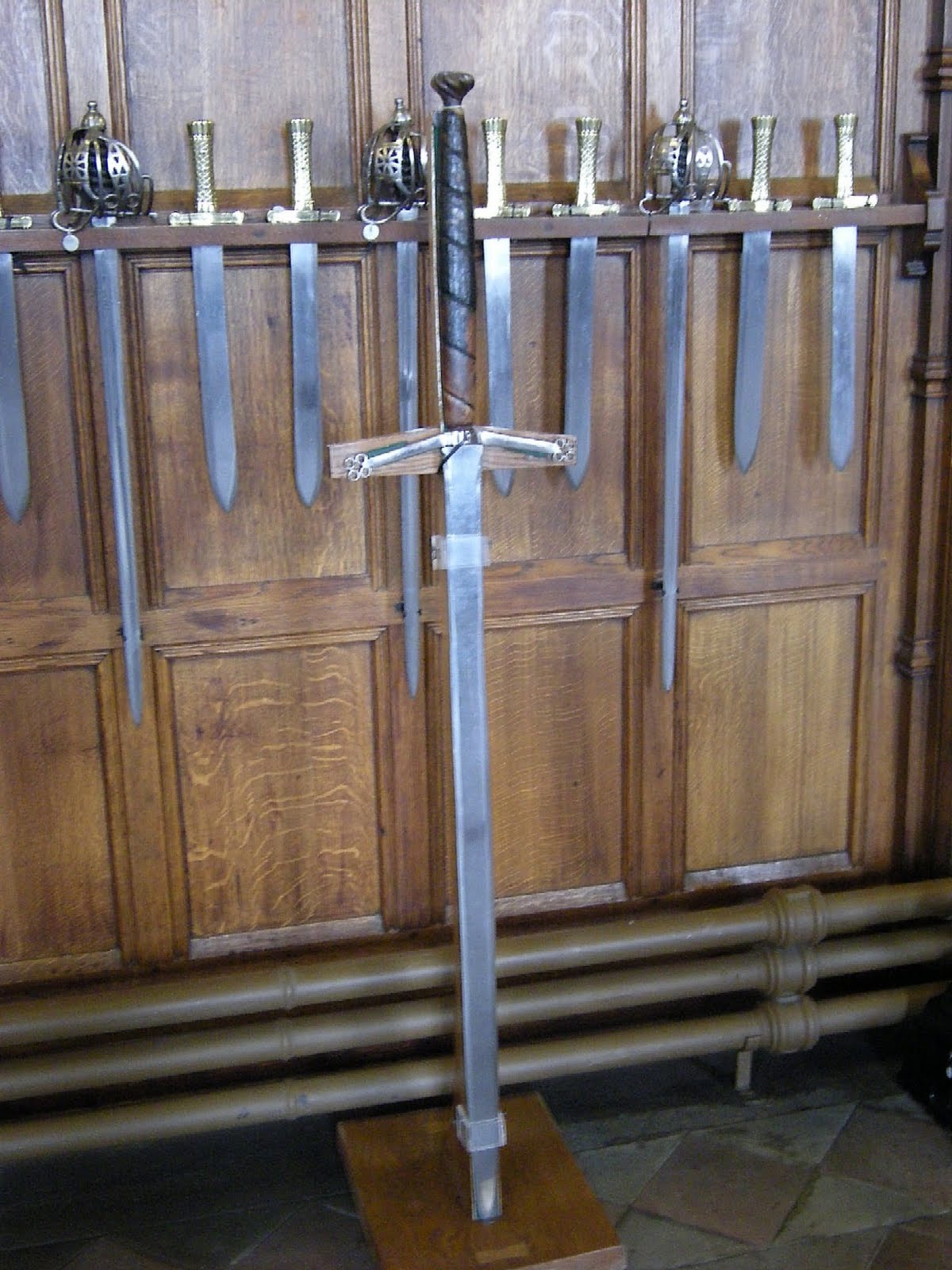
If you think the sword looks too big, take a look at the picture below.
Two-handed 'Highland' claymore
(Edinburgh Castle)
Note the size of the original claymore compared to that of a later basket-hilted sword on either side (which are normally referred to as claymores). This style of weapon is based on early Scottish medieval swords.

Tuesday, 9 August 2011

Montrose Irish, Warlord Games - Part 2

I've finally managed to take pictures of the Warlord Games Montrose Irish command group. I actually finished painting these figures a few weeks ago but I've been on my hols. The main group can be seen in this previous post: Montrose Irish part 1.
Commander
Commander
Drummer
Drummer
The flags supplied in the box set are, I believe, all conjectural. Seeing as they are Irish and not wishing to waste the opportunity for a cliché my brother opted for the green flag.
Ensign
Ensign
Ensign
The ensign originally carried an integral moulded metal flagstaff. I think Warlord must have realised that this pole was too flimsy as the box contains five metal pike although there are only four pikemen in the set. After removing the soft metal flagstaff I drilled out a hole though the figure’s hand and replaced the flagstaff with a cut down metal pike. I can understand why Warlord provided the figure complete with flagpole as the majority of people purchasing the set probably don’t to want to mess around cutting, carving and gluing metal models but I think it’s worth the effort (there’s nothing worse than having a droopy flagpole).

Warlord print their free flags on the relatively thick paper of the information leaflet that comes with the box set. Whenever I've tried to make the flags appear windswept I've found the papers creases and the white paper shows through the printing. In order to cover up these I paint, or use a wash, to fill in the cracks.

I also paint the edges of the flag with the appropriate colour so that the white line of the paper is no longer visible. 
Sergeant
Sergeant
I've just returned from a holiday up north (Carlisle, Edinburgh, Newcastle and York) where we saw numerous sites and artefacts associated with the Marquis of Montrose himself. I hope to post a separate article detailing these soon.

I recently purchased the Warlord miniatures of Alasdair 'The Devastator' MacColla and the Highland hero which I'll add as and when they're painted (but don't hold your breath).

Saturday, 16 July 2011

Charles I and the Isle of Wight

My brother and myself recently returned from the sunny Isle of Wight. One of the main historical attractions there is Carisbrooke Castle. The most famous resident of the castle was, of course Charles I. The onsite museum contains Civil War armour and more interestingly several personal possessions of King Charles I.The majority of the notes below are taken verbatim from the information panels at the castle

“Defeated in the English Civil War which had raged since 1642, King Charles I was under house arrest at Carisbrooke for 10 months in 1647-1648.

At first he had the freedom of the island but early in 1648 John Burley of Newport tried to free him, failed and was hanged. Afterwards Charles was confined to the castle. Still he could walk and play bowels on a green made for him."
View of Carisbrooke Castle from the gatehouse looking towards the motte. Charles’s bedroom was located in the central building behind the ten paneled window in the middle of the picture. The large glazed window replaced a much smaller one. The second attempt was from ruined buildings to the left
Aided by his page, Henry Firebrace, the king tried to escape twice more. In the first attempt he climbed through a window in his bedchamber but he got stuck in the bars."

King Charles slept here (although not in this bed)
Medieval fireplace, King Charles I's bedroom
“This room was the king’s bedroom during his first five months at the castle, from November 1647 to April 1648.

At first he was treated as a quest, but in January he became a prisoner, and guards were place on his bedroom doors. Charles attempted to escape from a small window in this room on the night of 20th March1648, assisted by his loyal servant Henry Firebrace.

There are many later additions here, but the king would have been familiar with the large medieval fireplace, and the medieval chapel window and squint (to the right of the bed).

The bed and chests are reproductions in the style of the 17th century. They have been installed to suggest the style of furniture brought here from Hampton Court in 1647.”

Ruined kitchen and bedroom block
Brother acting as money grabbing guard under the escape window
"The second attempt was made in this area, where kitchens and bedrooms had been built by George Carey 60years before. Charles tried to climb out of the window above... but he was betrayed by two guards. They had taken money to let him escape but then cruelly turned him in.”

On 29th November 1648 Charles was transferred across the Solent to Hurst Castle and then on to London for his trial and eventual execution 30th January 1649.

The isle wasn’t a happy place for the Stuart family.

Parliament was anxious that the children of King Charles could not be used any Royalist plot to restore the Monarchy. Princess Elizabeth and Henry Duke of Gloucester were moved to the Isle of Wight when their brother Charles II arrived in Scotland. It was determined that the Royal children should be imprisoned in Carisbrooke Castle. They arrived at Cowes on 13th August 1650.

Never blessed with strong health Elizabeth died, aged 14, on 8th September 1650 probably from pneumonia and was later buried in St. Thomas Church, Newport.

The church fell into disrepair and the princess’s grave was forgotten until 1793 when it was rediscovered by accident. When Queen Victoria and Prince Albert made the Isle of Wight their family home they felt the final resting place of one of the forebears needed a decent memorial hence the sculptured monument that marks Princess Elizabeth’s final resting place.
18th Century nameplate
Sculpture by Carlo Marochetti
St. Thomas's Church in Newport, Isle of Wight
.
Henry Duke of Gloucester was allowed to move to the Continent where he fought against the Spanish. Shortly after the Restoration he died from smallpox, 18th September 1660, aged 20.

Thursday, 14 July 2011

TV Celebrity Manhandles My Miniatures

After a inside tip-off I was recommended to watch the recent History Cold Case programme where "Professor Sue Black and her team use forensic science to shed light on the past. They look at two skeletons discovered among 113 bodies in a mass grave outside York."

After 20 minutes into 'The York 113' episode, featuring a certain Dr. Xanthe Mallett, I was quite taken aback to recognise several miniatures I had painted for Warlord Games. Mine are the Covenanter infantry and dragoons (they're all the ones with the blue bonnets). Hopefully I will be able to detail more of these figures quite soon.

I believe the programme may only be available in the UK (i.e. to B.B.C. licence payers) and can only be viewed over the next few days. It's a interesting programme which indeed challenged a number of my pre-conceptions about this historic time period. 

Dr. Xanthe Mallett is now my favourite forensic anthropologist (if only for the pulp fiction name). Admittedly that's quite a narrow field of interest but she is definitely now my favourite television expert.

Wednesday, 15 June 2011

Montrose Irish, Warlord Games - Part 1

The Montrose Irish boxed set from Warlord Games contains four metal pike, four metal command and sixteen metal musket figures. I won’t repeat the history of the unit that these figures represent as that is all contained on the colour leaflet supplied with the box. And there’s more info readily available on the t’internet about James Graham, 1st Marquess of Montrose himself. I did notice from the notes that Montrose was actually associated with Newcastles Whitecoats during the war, which is a nice coincidence figure-wise.

The only instance of any Irish regulars serving in the midlands that I know of is that of soldiers that formed part of the Lord Loughborough’s garrison during the siege of Ashby de la Zouch castle in 1644.


I restricted the use of faux tartan to the blankets, although I think I still may have got carried away when it came to painting some the plaid. The leaflet in the box says that these soldiers wouldn’t have carried chocolate box style tartan. Naturally I followed this advice and chose instead to go for a shortbread tin style tartan look. Even then I had to tone down (well ok, completely repaint) a few of the patterns as some of the figures started to look like members of a flamboyant ‘Bay City Rollers’ tribute act.

It seems that for many miniature painters (that’s people who paint miniatures, not tiny painters) tartan is a dirty word and is too much of an effort to even attempt. However following this very useful guide I find painting a tartan effect relatively easy. The only trick or tip I believe is being able to paint in straight lines. I would not recommend using tins of shortbread as a colour reference (even though it may appear that I did). With the godsend that is ‘Google images’ it’s always easier to copy from a real image than trying to rely on just your imagination.


A number of these miniatures have been sculpted to represent war weary campaign soldiers with raggedy trousers and bare feet. A couple even are about to chuck a great big stone at the enemy. These are probably how a great deal of veteran Irish, Scottish and indeed English Royalist troops looked like towards the end of the wars. I’ve read an account that described how highlander soldiers (who you would imagine would have been highly distinctive) were only recognizable as such because they were the only ones who could cope with the squalid conditions whilst they were being held captive inside a cathedral.

As usual these metal figures from Warlord paint up very nicely. The majority of them have been painted with the distinctive white trousers associated with the Irish, an ‘interesting fact’ new to me. Using the excellent Peter Dennis box art as a guide, I painted the uniforms of the soldiers in various colours. There are at least four different shades of green/olive drab and a few with my special version of Hodden grey (IT ISN’T GREY!), made out of a secret blend of 11 shades and colours of acrylic paint, ok it’s actually only three different colours but it’s still a bugger to prepare.


I also adopted a simpler method of finishing the faces on a number of the figures as they appear to have a bit of a squint. Rather than painting the whites of the eye I simply used a technical pen to create the pupil. This is probably a more realistic approach as it avoids the startled ‘Blimey, I’ve just been given a wedgie!’ look.

All the miniatures are based individually as I intend to use these in the same way as highland Scottish figures, as a rabble or skirmish line. If I ever feel the need to use the figures in a larger group I’ll simply attach them using Blu-Tack to a normal 40 x 40mm base.

Part 2 of this topic will detail the four command figures (well, it will do after I've actually finished painting them).

Tuesday, 24 May 2011

The Lunt Roman Fort

The Lunt Roman Fort is a reconstructed first century wooden Roman fort located just outside Coventry, in the village of Baginton, Warwickshire. The fort has more or less remained the same since I first visited the site when I was a child back into the sunny 70's. The fort is probably best know for its distinctive bulging outline, unlike any other known Roman fort.


The fort is unusual as it makes the best use of the landscape utilising a high plateau with a steep bank sloping down to the river Sowe rather than the traditional Roman method of building in straight lines creating the usual playing card shape regardless of the location.

The site was discovered in the 1930's, excavated in the 1960's and reconstructed in the early 1970's.
Approach to fort.
Eastern Gateway entrance.
View of collapsed wall section.
View of gate from inside fort. 
The Royal Engineers reconstructed the Porta Principalis Sinistra (eastern gate) in September 1970. The design was based on examples from Trajan's Column in Rome and was consistent with the archaeological evidence for a double gate with no guard chambers. It was discovered from reconstruction that it would take ten men using a single pole with pulleys and guidelines to easily haul the individual sections into place. The gateway took three days to reconstruct. I imagine that experienced Roman military engineers could complete the same task somewhat quicker.

Model of fort within the granary/museum
Full size Cavalry reconstruction
Note the horse harness double phallic hangers visible just below the lower tip of the shield. This a copy from an original found on the site.
Gyrus
The reconstruction of the Gyrus was completed in 1977. Eighteen men from 31 Base Squadron working six hours a day took ten days to complete it. The large circular feature is unique in the Roman Empire. It is 107ft (34.06m) in diameter and has a double-gated, funnelled entrance. The archaeological evidence suggests this was a cavalry training ring.

The Lunt may have been a centre for breaking and training horses seized from the Iceni – or Celtic horse people. Since horses were in constant demand by the army, they would be welcome spoils of war. A large wooden post in the centre of the Gyrus could be used for weapons practice, learning to cut and stab with the gladius (the short Roman sword) or throw and thrust with the pilum (spear).

I believe the fort earthworks have been left to fall into disrepair on purpose as local historians wanted to study the rate at which the walls collapsed.

Virtual Tour

Monday, 23 May 2011

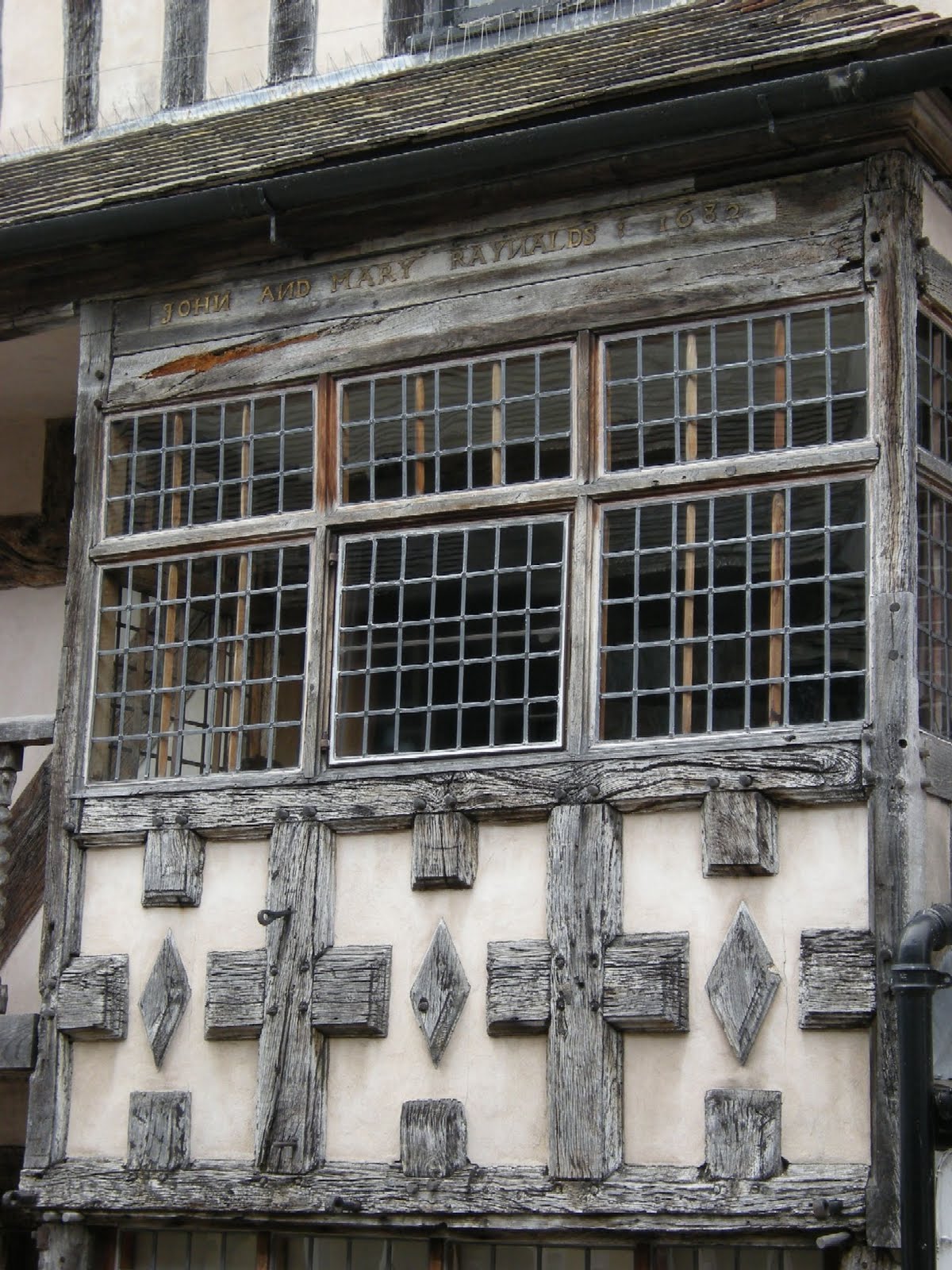
Raynalds Mansion, Much Wenlock

On a recent visit to Much Wenlock in sunny Shropshire I saw this building, Raynalds Mansion, on the High Street. Although one of the window frame carries the names of 'John and Mary Raynalds 1682' as far as I can find out the core of the building is actually a lot older. The building opposite for instance, The Talbot Inn, dates from 1360. I was particularly impressed by the purely decorative geometric patterns created by the wood work.


If I ever get the time I'd like to attempt to make a scale model of this building. I'm sure it would make an eye-catching addition to my meagre collection.